Plan Bay Area must be doing something right as it seems to be antagonizing those on both ends of the planning spectrum. First, a libertarian group sues because of "densification", and now environmentalists sue because not enough funds go for transit.


In this 4-minute audio news report, KQED news reporter Stephanie Martin speaks with Irene Gutierrez, an attorney with Earthjustice, about the lawsuit they filed on August 19 with Communities for a Better Environment and the Sierra Club against the Metropolitan Transportation Commission (MTC) and the Association of Bay Area Governments for approving a regional plan for "focusing too much on building new highways and not enough on public transportation."
The regional plan, called Plan Bay Area, was approved by the two regional agencies on July 18 as we wrote here. Required under state law SB 375, the "Sustainable Communities and Climate Protection Act of 2008", the "sustainable communities strategy" must meet greenhouse gas reduction targets approved by the California Air Resources Board. In fact, the plan (see page 7 of PDF) surpasses the targets initially approved by CARB: it would achieve 10 percent in 2020, 16 percent in 2035.
In response to Martin's question about why they sued and what they hope to get out of it, Gutierrez point to two major reasons: The transportation plan doesn't place enough emphasis on improving public transportation and not enough protection for impacted communities from increased freight transportation in the East Bay ports areas, i.e. environmental justice.
Martin pointed out that Plan Bay Area does attempt to influence transportation and land use patterns through its "Priority Development Areas" (and though she doesn't say it, it was a major reason for Plan Bay Area's first law suit by Pacific Legal Foundation). While Gutierrez was supportive of those efforts, she pointed to the flaw in the plan that Jason Henderson had revealed in the San Francisco Bay Guardian (and reposted here on July 26): failure to reduce vehicle trips by 2040.
From the Earthjustice press release:
- Under the current Plan, people will be spending more time in their cars and more time on the roads. Through 2040 (the life-span of the current plan), the number of daily vehicle trips is expected to increase by 22%, and the number of miles travelled during peak travel times is expected to increase by 51%.
This is not the first time a region's sustainable community strategy (i.e. regional plan required under SB 375) has been sued by environmentalists "for not going far enough", as we noted on Feb. 24, 2012: "San Diego Regional Transportation Plan Faces a Legal Battle From Environmentalists". The environmentalists won that case, forcing the regional planning agency for the San Diego area, San Diego Association of Governments (SANDAG), to redo their plan.
FULL STORY: Environmentalist Coalition Files Lawsuit Against Plan Bay Area Agencies

Environmentalists Settle Lawsuit on Plan Bay Area
Two down, two to go. Rarely has a regional transportation/land use plan been sued by so many diverse groups. Environmentalists settled with Bay Area regional planning agencies with assurances that the 2017 plan will better account for GHG reductions.
Gentrification and the Bay Area's Controversial Growth Management Plan
Is gentrification the inevitable result of land use planning that reduces greenhouse gas emissions by favoring infill development over auto-dependent sprawl? The Urban Displacement Project looks at the unintended effects of Plan Bay Area.
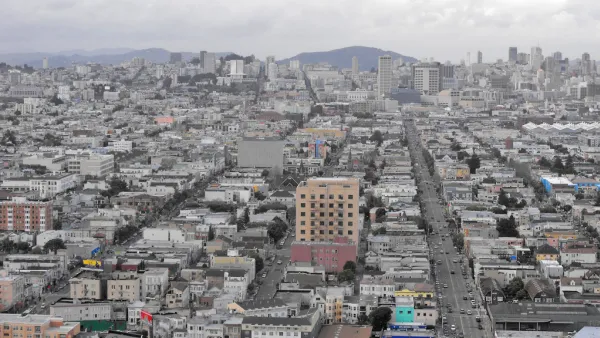
Density is Key to Fighting Climate Change, Rules Bay Area Judge
A group that coined the term, "stack and pack" to deride density and its role in reducing carbon emissions lost in court when the judge rejected their argument that only technological improvements in cars and fuels were necessary to reduce emissions.

The state-sanctioned urbicide of Austin
People don’t kill cities. Freeways do.

US to reduce Colorado River water deliveries to Mexico
A new Colorado Treaty amendment reduces Mexico’s Colorado River water allocation by 250,000 acre feet.

New Jersey’s second-largest city bans standalone data centers
Jersey City will continue to allow co-location facilities, such as those meant for research institutions that store their own data.

Amtrak not solely to blame for New Jersey commuter rail's unreliability, report finds
A new study from the Garden State Initiative found that NJ Transit’s budget grew 20% across a 4 year period, but reliability declined significantly over the same period.

EPA erases limits on planet-warming pollution from power plants
Under Monday’s plan, power plants would still have some limits on how much mercury, arsenic and other contaminants they can emit.

Phoenix announces new on-demand transit service, more frequent RAPID buses
Both new services will launch in October, and are part of Phoenix's Project Effective Access Solutions for Easing Congestion.

FREE Course: Walkable City 1: Why Walkability?
After describing his path towards focusing on walkability as the essence of good planning, Jeff Speck marches through his five principal reasons for making more walkable places.
Reinventing Malls: Planning Alchemy—Turning Gray Fields Into Gold
The course focuses on the opportunities and imperatives that shape reinvention of mall sites.

Eagle County Government
Harvard University Graduate School of Design
Nashville Planning Department
The Architects Foundation
University of Cincinnati Online
The Pocatello Development Authority
The Urban Renewal Agency of the City of Pocatello
Journal of the American Planning Association