Sacramento reporter John Myers suggests that if the oil industry and the Sierra Club both oppose a fracking bill - one for going too far; the other for not going far enough - then state Senator Fran Pavley's bill, "must be doing something right".


There are two specific issues in SB 4: Oil and gas: well stimulation that have these two parties who usually take opposing sides on energy and environmental legislation, joining forces: acidizing and disclosure clauses.
Acidizing, a form of 'oil well stimulation' "includes the uses of acid compounds to bring the oil to the surface" that unlike fracking, doesn't involve horizontal drilling. [See David R. Baker's August 25 article in the San Francisco Chronicle that contrasts acidizing with fracking and shows why the former may be more applicable to California's vast Monterey Shale that is said to hold the largest shale oil deposits in the U.S.].
When SB 4 passed the Senate on May 29, it covered only fracking. The subject title read, "Oil and gas: hydraulic fracturing". In the Assembly, it was amended to read, "Oil and gas - well stimulation" to the dismay of Paul Diero, a lobbyist for the Western States Petroleum Association, who appears in the accompanying 2:16 broadcast.
While the bill's author, Fran Pavley, received Sierra Club Calif's highest award in 2009 and is widely known for authoring California's landmark Light Duty Vehicle Greenhouse Gas Emissions Standards bill in 2004, Sierra Club California sees the lack of sufficient "public disclosure of the chemicals used in the fracking process" as sufficient reason to oppose the bill.
Kathryn Phillips [who also appears in the accompanying video], the organization's California director, says the public needs to know not just the chemicals involved but also the concentration of those chemicals being used -- information that the oil industry considers to be trade secrets.
However, Myers notes that the "Sierra Club finds itself virtually alone among politically active environmental groups; several other heavy hitters all support SB 4 as better than no legislation at all." [Scroll down the May 28 analysis to see a list of supporters and opponents]. While not disclosing the proprietary fracking mixtures to the public, the bill "mandates that oil companies disclose the precise mixture of fracking chemicals to state and local officials in the event of an emergency", according to Myers.
If the bill fails, there will be no legislative regulations overseeing the fracking and acidizing processes. However, as Scott Detrow writes in KQED News Fix on August 14, "The idea that fracking and acidizing are completely unregulated in California is popular but false. The Department of Conservation’s oil and gas division treats them as one aspect of the broader drilling process, which it permits and regulates." In addition, as Detrow wrote on March 22, the state has already prepared new fracking regulation that is winding its way through the public process for approval.
Read the full story: Fracking fight fractures some Capitol alliances


Planetizen Federal Action Tracker
A weekly monitor of how Trump’s orders and actions are impacting planners and planning in America.

Northwest rail fans eager for Sept. 30 debut of Amtrak’s Airo fleet
Get ready for that new train smell and more seats. But they won’t go faster or run more frequently on the Cascades route in Washington and Oregon.
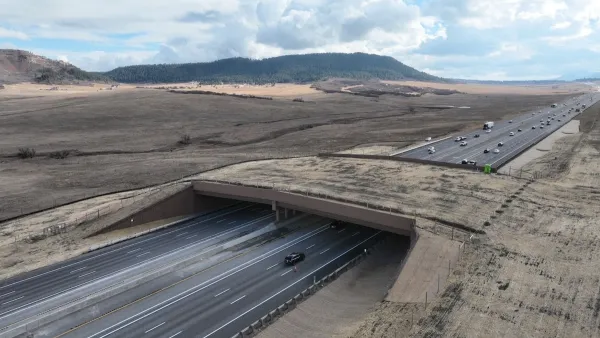
Record-breaking wildlife overpass in Colorado brings 91% reduction in animal collisions
Prior to the overpass, vehicles were hitting one deer per day on Colorado’s Interstate 25.

Detroit to transform waterfront with $2.2 billion investment
Developers will convert about 18 acres of unused parking lot space into civic spaces.

‘Going backwards:’ Baltimore mayor, students rally against state's transit funding plan
Maryland's proposed six-year plan provides no funding for Baltimore’s BMORE bus program and reduces its road maintenance funding.

Trump wants to cancel nearly 98% of funding for HUD housing support program
Multiple housing groups are suing the administration in an effort to preserve the funding.

FREE Course: Walkable City 1: Why Walkability?
After describing his path towards focusing on walkability as the essence of good planning, Jeff Speck marches through his five principal reasons for making more walkable places.
Reinventing Malls: Planning Alchemy—Turning Gray Fields Into Gold
The course focuses on the opportunities and imperatives that shape reinvention of mall sites.

City of Thousand Oaks
City of Wisconsin Rapids
Harvard University Graduate School of Design
The Architects Foundation
University of Cincinnati Online
Northern Illinois Transit Authority (NITA)
The Pocatello Development Authority
The Urban Renewal Agency of the City of Pocatello