California Air Resources Board Chairwoman Mary Nichols signed an agreement with Australia to share policy on reducing green house gas emissions. The Planning Report presents the following transcript of her remarks at the signing.


In late July, California Air Resources Board Chairwoman Mary Nichols and Australian Clean Energy Regulator Chair Chloe Monroe signed a Memorandum of Understanding on behalf of their respective countries and agencies, promising to share information about improving carbon market integrity and investing in clean technology. In a speech given at the signing, reprinted in The Planning Report, Chairwoman Nichols details the principals of California’s cap-and-trade program, noting that the state’s previous emissions regulations not only reduced pollution despite a tripling population, but also grew its clean technology sector to the largest in the nation.
Though California and Australia may not be ready to link their carbon markets, Nichols affirms they can partner to share knowledge, experience, and the challenges of cap-and-trade, while encouraging other regions to adopt similarly impactful policies towards climate change. California will proceed with linking its carbon market to that of the Canadian Province of Québec, expected sometime next year.
Read the full story: Mary Nichols: California Collaborating With Australia on Pricing Carbon Emissions

California Progress Report: GDP Increases While GHGs Fall
California is demonstrating that improving the economy and the environment go hand in hand. A new inventory report from the state's Air Resources Board notes changes in gross domestic product, population, and greenhouse gas emissions since 2000.

Coming in 2020: Electrification of Transportation, Including Trucks
Auto manufacturers will offer more battery and plug-in hybrid models this year, and the nation's largest state is expected to approve a new regulation requiring medium and heavy-duty truck manufacturers to sell zero-emission vehicles.
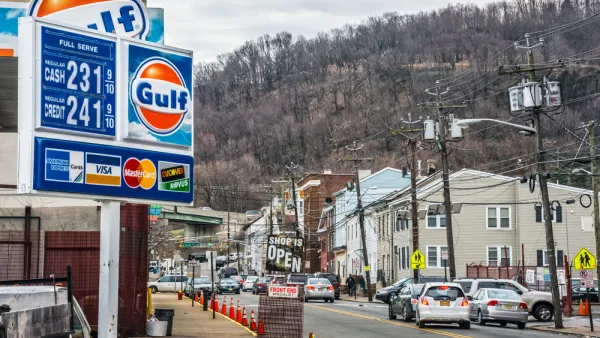
East Coast Considers Plan to Hike Gas Prices to Mitigate Climate Change
Will a dozen East Coast states and D.C. agree to a regional plan that would likely hike gas prices through a "cap-and-invest" program to mitigate tailpipe emissions similar to what California has done for the last five years?

Planetizen Federal Action Tracker
A weekly monitor of how Trump’s orders and actions are impacting planners and planning in America.

Eastern Nebraska is running out of electricity
Data centers and electrification are straining eastern Nebraska’s grid, throttling economic development.

Study reveals best places in the U.S. for cycling, walking
New research from Streetlight Data examines bicycle and pedestrian miles per capita in the 100 largest U.S. cities by population.

DSA members accuse Mamdani of 'abandoning values' over housing redevelopment
New York City's mayor plans to replace about 2,000 units of public housing with private, mixed-income housing.

All sides of BRT debate unhappy with CDOT’s most recent move
The Colorado Department of Transportation is no longer considering center-running bus lanes for Colorado Boulevard.

Massachusetts bogs generate both power, and cranberries
Putting solar panels above farmland is one way Massachusetts is advancing toward its goal of net-zero carbon emissions by 2050.

FREE Course: Walkable City 1: Why Walkability?
After describing his path towards focusing on walkability as the essence of good planning, Jeff Speck marches through his five principal reasons for making more walkable places.
Reinventing Malls: Planning Alchemy—Turning Gray Fields Into Gold
The course focuses on the opportunities and imperatives that shape reinvention of mall sites.

City of Rosemead
Rutgers University, Edward J. Bloustein School of Planning and Public Policy
One Hundred Miles
University of Michigan School for Environment and Sustainability (SEAS)
Hunter College, City University of New York (CUNY)
The Architects Foundation
City of Cambridge
The Pocatello Development Authority
The Urban Renewal Agency of the City of Pocatello