Traffic
Development Fails the Public Opinion Polls
A recent article for PlannersWeb called “10 Things You Should Know About How the Public Feels About Development” provides helpful data and insight into the type of opposition encountered whenever new development projects face public scrutiny.
Georgia Cracking Down on Fast-Lane 'Slow-Pokes'
A new bill approved by the state of Georgia's House of Representatives makes it illegal to remain in the fast lane when a faster vehicle approaches from behind.
Making the Case for Speeding
Not everyone likes the idea of slowing down, but sometimes advocacy for increased speed limits can come from surprising sources, like the editorial director of a UK journal for architects.
Self-Driving Cars Will Rule the Road by 2050
A new study by IHS Automotive predicts that 54 million self-driving cars will be on the road by 2035, and that every car will be autonomous by 2050.
Explaining Traffic Waves - the Likely Cause for Your Congested Commute
For many drivers, the only experience more aggravating than being stuck in traffic is not being able to figure out why there's a jam in the first place. An explanation of the phenomenon called "Traffic Waves" may help ease the aggravation.
Buttons of Death
"Push buttons" designed to protect pedestrians often don't.
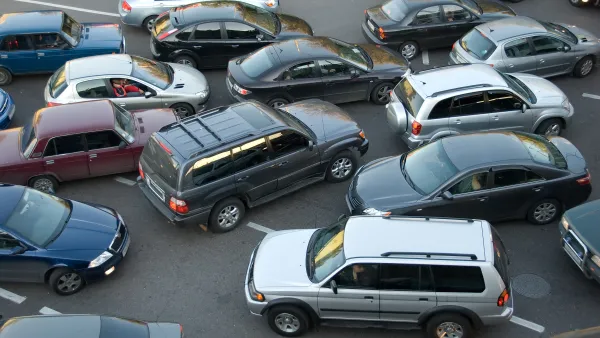
What Causes Traffic?
You're probably thinking "Way too many cars on the road, duh!" But the real answer is a bit more complicated, and counterintuitive. Tom Vanderbilt explains in a 20-minute presentation.
Bike and Pedestrian Improvements Boost Vehicle Speeds in NYC
New data from New York's Transportation Department shows that although miles of Manhattan street space have been turned over to bikes and pedestrians since 2008, average traffic speeds have actually increased, despite a consistent volume of vehicles.
Play Dismay: Traffic and the Epidemic of Cloistered Children
Sarah Goodyear examines the connection between the way we design our streets and the reluctance of parents to let their children play outdoors.
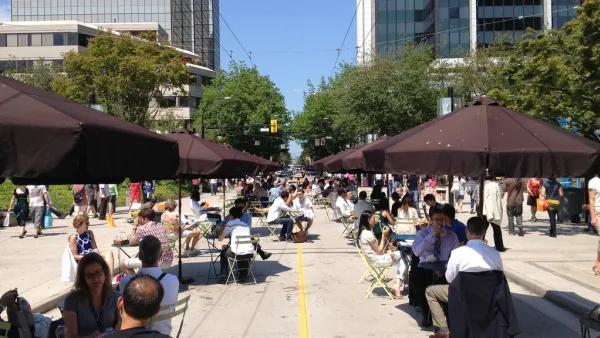
How Did Vancouver Decrease its Traffic While Growing its Population?
With its elegant skyline, walkable streets and stunning parks, Vancouver exemplifies great city-making. Add to the list of achievements the city's ability to reduce traffic by 20 to 30 percent since 2006 while growing its population by 4.5 percent.
Westside Fights Smart Growth: Can Any Development Navigate L.A.'s Traffic Nightmare?
On the Westside of L.A., where rush hour traffic slows to a crawl on the best days, a proposed transit-oriented development called the 'quintessential example' of smart growth by the Mayor's staff faces opposition to its size and attraction to autos.
"Bike Breaks" Leverage Dynamic Resources for Synergistic Efficiency Improvements (they really do!)
Using bicycle racks as partitions in lieu of fences, called "bike breaks", in heavily trafficked areas accomplishes two goals at once and fends off the design wonks.
D.C. Mustn't Look Far to Find Lessons for Reducing the Nation's Worst Congestion
Washington D.C. holds the dubious distinction as the nation's most congested city. As D.C. seeks ways to reduce its traffic, Arlington County, in suburban Virginia, has made great strides in convincing commuters to ditch their cars.
Better Traffic Flow Is a Two-Way Street
Cities such as Dallas, Denver, Sacramento and Tampa are reversing course on their one-way streets for a number of reasons; but improving traffic flow likely isn't one of them. Eric Jaffe looks at a recent study that upends conventional wisdom.
A Simple Solution to Kabul's Massive Traffic Problem
The proposal is simple. Instead of investing billions of dollars more on elaborate infrastructure or trust a corrupted police force, the concept is to nudge this complex system at two targeted points in the city, argues Mitchell Sutika Sipus.
Can Narrow Lanes Improve Traffic Congestion?
Comparing wide versus narrow lanes, Kenneth A. Small and Chen Feng Ng examine the relatively unexplored design of building more compact roads to alleviate traffic congestion.
Why Public Spaces Are Crucial for 'the Future of the Human Race'
Jay Walljasper chronicles the decline of lively public spaces in the era of "rampant traffic, proliferating privatization, heightened security...and the internet," and human kind's existential need for protecting and expanding the public realm.
NYC's Taxis Offer Rare Insights into City Driving Patterns
With New York's fleet of more than 13,000 taxi cabs transmitting Global Positioning System (GPS) data, the city's Department of Transportation has been able to develop a highly detailed picture of traffic patterns in the Big Apple.
Chinese Cities are Huge, But What's it Like to Live There?
We get it, China's cities are big and getting bigger. But what's it like to live there? Isaac Stone Fish takes a closer look at the quality of life in Chinese cities, and finds them almost uniformly monolithic and unlivable.
Where are the Worst Friday Commutes?
Your boss might be interested in this article, which makes the case for working extra long on Fridays to avoid what, in nearly three-quarters of metros across America, is the worst time of the week to drive. Mike Maciag looks at the worst offenders.

FREE Course: Walkable City 1: Why Walkability?
After describing his path towards focusing on walkability as the essence of good planning, Jeff Speck marches through his five principal reasons for making more walkable places.
Reinventing Malls: Planning Alchemy—Turning Gray Fields Into Gold
The course focuses on the opportunities and imperatives that shape reinvention of mall sites.

City of Rosemead
Rutgers University, Edward J. Bloustein School of Planning and Public Policy
One Hundred Miles
University of Michigan School for Environment and Sustainability (SEAS)
Hunter College, City University of New York (CUNY)
The Architects Foundation
City of Cambridge
Montrose County
The Pocatello Development Authority









