Imbalances between the amount of cars being added to the roadways in China's cities and the amount of roads for them to drive on is brewing a major traffic problem.


"'The number of cars is going up much faster in China than the length of the roads in the cities,' Schipper said. 'The greatest ‘communist' society ever invented doesn't know what to do. That's what worries me. Cars are not something any kind of government can easily control if they're cheap to buy and cheap to drive.'
In Shanghai, a city of more than 20 million where new car registrations are restricted to 6,000 monthly, commuter traffic has slowed to 6 to 10 miles per hour, well under the speed of a bicycle. The traffic's a mess, even though only 20 percent of all daily trips in Shanghai are by car, compared to 80 percent in U.S. cities. For the majority of Shanghaians, who are walking or biking or waiting at the bus stops, it means breathing in a lot of bad air."
But some researchers say it's not too late for China to avoid crippling car traffic problems.
Read the full story: Can China Avoid Getting Stuck in Traffic?
A Video Explanation of Congestion Pricing
This video from Streetfilms explains the concept of congestion pricing and looks at how it can affect cities and their mobility.
Congestion Costing Reality Check, Part 2: A congestion costing critique
There are good reasons to be skeptical of highway industry claims that traffic congestion is a growing problem. Their analysis is often incomplete and biased. Let’s pull back the curtain on some major congestion cost studies.
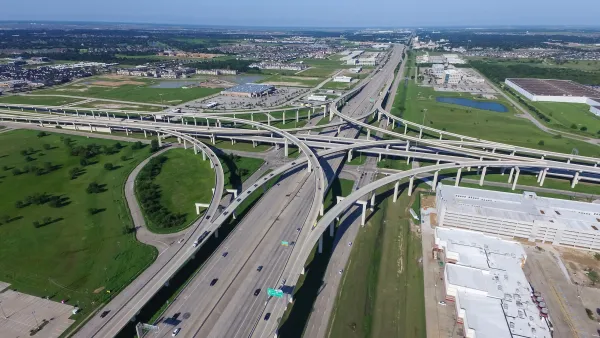
Induced demand is real: Commutes on Houston's 26-lane freeway take 51% longer after expansion
A massive freeway expansion only led to longer drive times, showing that building more lanes won't solve congestion.

Washington state to charge fee to drivers with fuel-efficient cars
Revenue from the fee will go towards supporting the state’s highways.

Illinois considers spending $1 billion in taxpayer money on data center
A quantum computing campus and data center are currently under construction in Chicago.

Trump to blast ‘hydrocarbon highway’ through ‘world’s longest art gallery’
Environmental and historic preservation groups are suing to stop the project.

NYC, state sue feds over mixed-immigration-status housing assistance rule
The state’s lawsuit argues that the rule change violates the Administrative Procedure Act.

Michigan to turn neighborhood into virtual power plant
Residents will soon be able to divert their excess energy to the grid in exchange for compensation.

Data center, mining project swarm to long-awaited Alaska railroad line
The state-owned railroad approved final plans for the spur line this week; the project is expected to cost $311 million, mostly funded by the federal government

FREE Course: Walkable City 1: Why Walkability?
After describing his path towards focusing on walkability as the essence of good planning, Jeff Speck marches through his five principal reasons for making more walkable places.
Reinventing Malls: Planning Alchemy—Turning Gray Fields Into Gold
The course focuses on the opportunities and imperatives that shape reinvention of mall sites.

City of Charlotte
City of Rosemead
Rutgers University, Edward J. Bloustein School of Planning and Public Policy
University of Michigan School for Environment and Sustainability (SEAS)
Hunter College, City University of New York (CUNY)
The Architects Foundation
University District Partnership