A wave of investments is visiting one of the most famous, and notorious, neighborhoods in the city of Chicago. The question is whether the final product will be worth the expense.


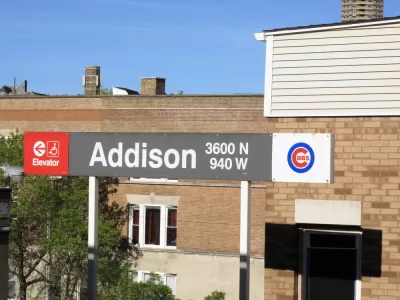
Blair Kamin provides commentary on the large-scale redevelopment going on in the neighborhood immediately surrounding Wrigley Field in Chicago—finding reasons to be concerned that the quality of future developments will match the neighborhoods role as a hub of activity in the city.
"The outcome will speak to an issue that resounds far beyond Chicago: Whether public officials can effectively manage the growing phenomenon of 'transit-oriented development,' which encourages high-density construction near transit and commuter rail stops to cut down on car use and save energy," writes Kamin
Two of the larger projects under discussion $2.1 billion Red and Purple lines modernization project, which requires the demolition of 14 structures, and a $1 billion investment by the Cubs that includes renovations at the ballpark, a new outdoor plaza, a new office building for the team, and a new hotel. Nearby there's also a new development called Addison & Clark, an eight-story building that includes apartments, shops, and a movie theater.
With all of this development potential, Kamin sees need for a warning.
Transit-oriented development — TOD, for short — may sound good in theory, but some developers use it as an pretext for bulked-up buildings that are oversized eyesores and dwarf their delicate-scaled neighborhoods. Examples now blight the otherwise attractive downtowns of suburbs like Wilmette and La Grange.
Kamin offers prescription to prevent TOD, which you can read at the full article.
FULL STORY: Around Wrigley Field, a high-stakes urban design drama plays out as buildings fall and rise

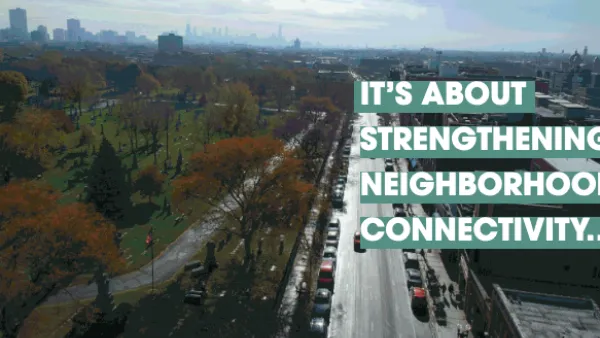
Chicago Seeks Public Input on Clark Street Improvements
The city is creating a strategy for improvements in the Clark Street corridor to improve the area's walkability and stimulate the local economy.
Opportunity Zone Investors Look to Fuel Tech in Chicago
One venture plans to fund a 100-acre campus for tech, bioscience, and medical research in Chicago's Bronzeville neighborhood.
Researchers Find a Model of Redevelopment Without Displacement
It's the "holy grail" of urban planning, say researchers.

Planetizen Federal Action Tracker
A weekly monitor of how Trump’s orders and actions are impacting planners and planning in America.

The state-sanctioned urbicide of Austin
People don’t kill cities. Freeways do.

US to reduce Colorado River water deliveries to Mexico
A new Colorado Treaty amendment reduces Mexico’s Colorado River water allocation by 250,000 acre feet.

5 New England states march closer to 800 megawatt wind energy project
Securing federal approval for the project may be complicated under the Trump administration, which has historically been hostile towards domestic wind power.

Baltimore to break ground on $50 million Transit Priority Project
The project will bring faster bus trips, safer streets and better bike connections to Baltimore.

Airbnb launches $250 million 'last-dollar financing' housing accelerator, makes first investment in Austin
The company will put $6.4 million towards affordable housing development in Texas’ capital.

FREE Course: Walkable City 1: Why Walkability?
After describing his path towards focusing on walkability as the essence of good planning, Jeff Speck marches through his five principal reasons for making more walkable places.
Reinventing Malls: Planning Alchemy—Turning Gray Fields Into Gold
The course focuses on the opportunities and imperatives that shape reinvention of mall sites.

Eagle County Government
Harvard University Graduate School of Design
Nashville Planning Department
The Architects Foundation
University of Cincinnati Online
The Pocatello Development Authority
The Urban Renewal Agency of the City of Pocatello
Journal of the American Planning Association