Urbanists and planners might consider looking at the development outside U.S. Bank Stadium in Minneapolis on Super Bowl Sunday. Gone are the vast parking lots surrounding the Metrodome, replaced with mixed use and a popular park, the Commons.


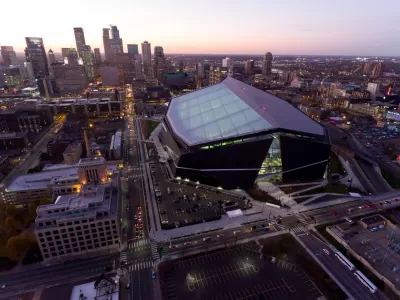
"[F]ootball fans returning to the city to watch the New England Patriots and Philadelphia Eagles compete in Super Bowl LII on Feb. 4 are not likely to recognize the area, now known as East Town [formerly Downtown East or East Downtown]," writes freelance journalist, Joe Gose, in the Square Feet column of The New York Times on Jan. 23.
The Metrodome, a walled-in colossus that dominated the barren landscape from 1982 to 2014, has been replaced by U.S. Bank Stadium, which opened in 2016. The roughly $1.1 billion bright and transparent edifice, designed by HKS architects, features a mostly clear, steep roof and has been likened to a Nordic long house, a Viking warship and an ice shard formation.
New offices, apartments, hotels, restaurants and a 4.2-acre park known as the Commons have replaced the parking lots. In all, more than $2 billion in private and public investment has been injected into East Town, according to the East Town Business Partnership, an organization that promotes the roughly 120-block district, which is bordered generally by the Mississippi River, downtown and three interstates.
About five of the original 15 blocks of parking lots still remain, said George Sherman, principal of Sherman Associates, a developer in East Town. “I doubt if there will be any that haven’t been developed in the next two to three years.”
Over half of the original $975 million cost of the stadium came from of state and city funds. Opponents pointed to Metrodome's failure to generate economic development, a reason in itself to avoid providing plentiful parking for stadium events.
The Commons park played a prominent role in encouraging developers to invest in the area.
“When we first looked at the opportunity, we thought there was too much land — there was going to be a great new stadium, but there was nothing to prevent the area from being another sea of surface parking,” said developer Mike Ryan. “But having a major public green space at its core is the reason developers want to be there.”
As for Minneapolis reaping an economic windfall from the game, "economists say its overstated," writes Kevin Draper, a sports business reporter for The New York Times, on Jan. 29.
Getting to the game
East Town and the stadium are served directly by Metro Transit's Blue and Green light rail lines and bus lines, with connecting light rail service from Northstar Commuter Rail. "Ticket holders who buy a $30 'game day' pass will get a nonstop [light rail] ride from a security screening area directly to U.S. Bank Stadium for the game," wrote Sam Newberg, a Minneapolis-based urbanist and Planetizen contributor, on Nov. 19, 2017.
For more reading in Planetizen on the East Town development, see:
-
April 16, 2015, Minneapolis Star TribuneA new park and lots of new development will follow the under-construction stadium for the Vikings on the eastern side of Minneapolis urban core.
-
June 1, 2013, Minneapolis Star TribuneDevelopers have announced plans for 'one of the largest real estate projects in Minneapolis history.' The ambitious proposal for a five block area in the city's downtown east neighborhood could be a catalyst to transform the 'largely barren' area.
FULL STORY: Super Bowl’s Minneapolis Stadium Brings a Surge in Development

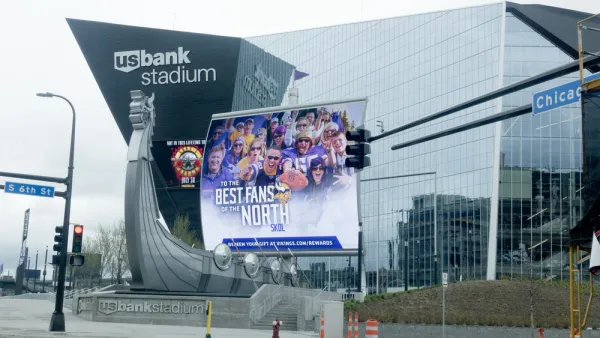
Inside the 2018 Super Bowl's 'Luxified' Venue
When the Eagles and the Patriots face off this weekend, they'll do it at Minneapolis' U.S. Bank Stadium, a billion-dollar venue that "aspires to more than football."
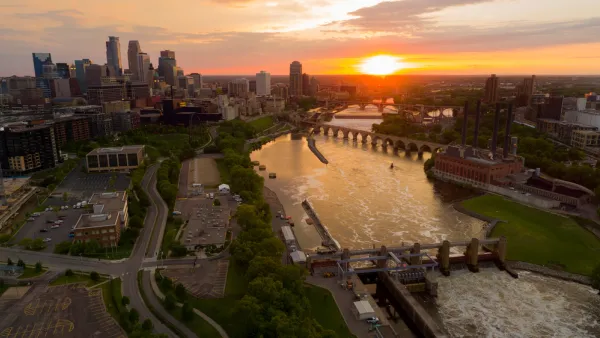
Downtown Revitalization Stretches East in Minneapolis
East Town, also known as Downtown East, used to be "weed strewn lots and abandoned rail yards."
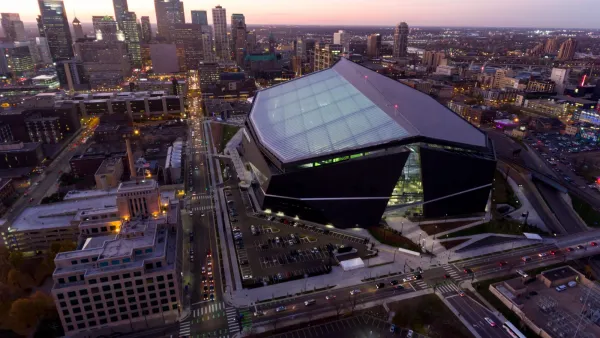
Light Rail Reserved for Ticket Holders on Super Bowl Sunday
Metro Transit's decision to use light rail service for Super Bowl ticket holders rankles some who will be forced to take the bus

The state-sanctioned urbicide of Austin
People don’t kill cities. Freeways do.

US to reduce Colorado River water deliveries to Mexico
A new Colorado Treaty amendment reduces Mexico’s Colorado River water allocation by 250,000 acre feet.

New Jersey’s second-largest city bans standalone data centers
Jersey City will continue to allow co-location facilities, such as those meant for research institutions that store their own data.

Amtrak not solely to blame for New Jersey commuter rail's unreliability, report finds
A new study from the Garden State Initiative found that NJ Transit’s budget grew 20% across a 4 year period, but reliability declined significantly over the same period.

EPA erases limits on planet-warming pollution from power plants
Under Monday’s plan, power plants would still have some limits on how much mercury, arsenic and other contaminants they can emit.

Phoenix announces new on-demand transit service, more frequent RAPID buses
Both new services will launch in October, and are part of Phoenix's Project Effective Access Solutions for Easing Congestion.

FREE Course: Walkable City 1: Why Walkability?
After describing his path towards focusing on walkability as the essence of good planning, Jeff Speck marches through his five principal reasons for making more walkable places.
Reinventing Malls: Planning Alchemy—Turning Gray Fields Into Gold
The course focuses on the opportunities and imperatives that shape reinvention of mall sites.

Eagle County Government
Harvard University Graduate School of Design
Nashville Planning Department
The Architects Foundation
University of Cincinnati Online
The Pocatello Development Authority
The Urban Renewal Agency of the City of Pocatello
Journal of the American Planning Association