The first protectionist policies implemented by the Trump Administration, a key part of the president's campaign platform, will affect the renewable energy industry.


"President Trump slapped steep tariffs on imports of washing machines and solar energy cells and panels on Monday, the first major step by the administration to erect the kind of trade barriers Mr. Trump has frequently said are necessary to protect manufacturers in the United States," report Ana Swanson and Brad Plumer.
The tariffs are the first of an expected series of trade measures that could eventually also reach industries like steel, aluminum, and other products. For now, however, the solar industry and environmentalists are scrambling to make sense of the new policy.
After breaking the news of the new tariffs, Swanson and Plumer wrote a separate article that digs into the human-and-corporate-interest angle of the news. While two solar companies, Suniva and SolarWorld sought the tariffs, "they are expected to ripple throughout the industry in ways that may ultimately hurt American companies and their workers," according to Swanson and Plumer. Moreover, "[e]nergy experts say it is unlikely that the tariffs will create more than a small number of American solar manufacturing jobs, since low-wage countries will continue to have a competitive edge."
Furthering the idea that the tariffs won't be a boon for the entire solar industry, Andrew Maykuth writes an article that checks-in with local solar installation companies in Philadelphia, where the owner of one business is very pessimistic about the effects of the tariffs.
And in a potential surprise take, Al Gore took to the stage at the World Economic Forum in Davos and defended the action by President Trump, saying the tariffs are not "an utter catastrophe."
FULL STORY: rump Slaps Steep Tariffs on Foreign Washing Machines and Solar Products

Transportation Secretary's Resignation Announcement Greeted With Derision
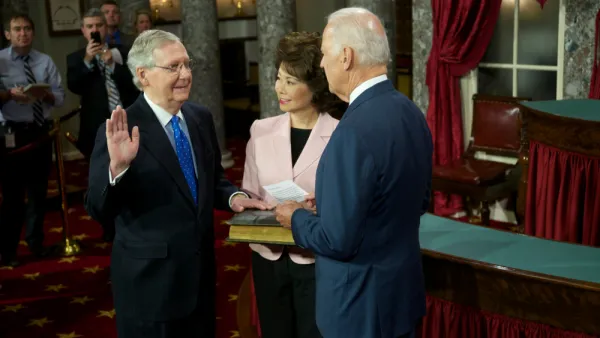
Transportation Secretary Elaine Chao became the first cabinet secretary to announce her resignation due to the storming of the Capitol by Trump supporters, but at least one high-profile member of congress has derided the announcement.
Trump's Legacy: Climate Change
The Biden administration and effects of time will erase some of the consequences of the Trump administration's methodical dismantling of the nation's environmental regulation. But climate change will be around longer than any of it.

What Biden's Win Could Mean for Land Use, Transportation, and Climate
Campaign in poetry and govern in prose, the saying goes. Now that the reality of a Biden presidency is settling in, what does it mean for how the United States plans its future?

Planetizen Federal Action Tracker
A weekly monitor of how Trump’s orders and actions are impacting planners and planning in America.

The state-sanctioned urbicide of Austin
People don’t kill cities. Freeways do.

US to reduce Colorado River water deliveries to Mexico
A new Colorado Treaty amendment reduces Mexico’s Colorado River water allocation by 250,000 acre feet.

Mamdani overhauls NYC's Vision Zero plan with 100 new policy goals
The overhaul aims to reduce traffic deaths and make streets safer for pedestrians, cyclists and drivers through lower speed limits, new safety infrastructure and more.

Amtrak not solely to blame for New Jersey commuter rail's unreliability, report finds
A new study from the Garden State Initiative found that NJ Transit’s budget grew 20% across a 4 year period, but reliability declined significantly over the same period.

EPA erases limits on planet-warming pollution from power plants
Under Monday’s plan, power plants would still have some limits on how much mercury, arsenic and other contaminants they can emit.

FREE Course: Walkable City 1: Why Walkability?
After describing his path towards focusing on walkability as the essence of good planning, Jeff Speck marches through his five principal reasons for making more walkable places.
Reinventing Malls: Planning Alchemy—Turning Gray Fields Into Gold
The course focuses on the opportunities and imperatives that shape reinvention of mall sites.

Eagle County Government
Harvard University Graduate School of Design
Nashville Planning Department
The Architects Foundation
University of Cincinnati Online
The Pocatello Development Authority
The Urban Renewal Agency of the City of Pocatello
Journal of the American Planning Association