File under 'high-tech urban dystopia.”



After public backlash, an "autonomous security robot" deployed to ward off homeless people has been retired.
"The San Francisco SPCA, an animal advocacy and pet adoption group, put a security robot to work outside its facilities in the gentrifying Mission neighborhood … to deter homeless people from setting up camps along the sidewalks," reports Business Insider.
The robot, K9—which is plastered in pictures of cute animals—is part of a fleet created by Mountain View startup Knightscope. They're used by companies including Uber and Microsoft as a cheaper, "superhuman" replacement for human security guards.
"The company's robots don't fight humans," Business Insider assures readers. "They use equipment like lasers, cameras, a thermal sensor, and GPS to detect criminal activity and alert the authorities."
That wasn't enough to placate the many people who expressed outrage and disappointment on Twitter before the bot was retired; some expressed particular frustration that the anti-homeless campaign was launched by an animal shelter.
Read the full story: Robots are being used to deter homeless people from setting up camp in San Francisco


Study: LA’s Homelessness Program Displaced 5 People for Every One it Helped
Researchers say a city program designed to help people access housing and services “does not live up to its name” and has caused more harm than good.

San Francisco Could Ban Overnight RV Parking
Advocates say the proposal would further destabilize the lives of people forced to live in their vehicles.
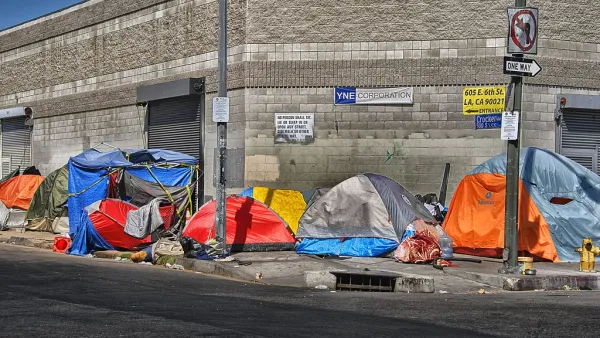
Homelessness Fuels a Backlash in California
The Golden State's ongoing homelessness crisis has residents on edge and is testing the limits of empathy in a state known for its liberal values.

Planetizen Federal Action Tracker
A weekly monitor of how Trump’s orders and actions are impacting planners and planning in America.

California plans to bury El Niño’s downpour
If the state plays its cards right, it may be able to store a billion acre-feet of El Niño’s water in aquifers.

Chicago breaks ground on $3 billion megadevelopment
The new neighborhood, titled Foundry Park, will one day host 3,700 residences.

California High-Speed Rail Authority CEO resigns after $600,000 scandal
Under Ian Choudri, the authority used taxpayer dollars to fund first class flights and trips to nightclubs.

Want to study the Missouri River? Soon, you may need unanimous approval from 10 states
Legislation would require 10 governors’ permission to study or build projects moving water outside the basin.

Desperate measures: Advocates weigh draining Lake Powell to fill Colorado River
Draining the reservoir could reduce evaporation losses by a couple hundred thousand acre-feet.

FREE Course: Walkable City 1: Why Walkability?
After describing his path towards focusing on walkability as the essence of good planning, Jeff Speck marches through his five principal reasons for making more walkable places.
Reinventing Malls: Planning Alchemy—Turning Gray Fields Into Gold
The course focuses on the opportunities and imperatives that shape reinvention of mall sites.

City of Rosemead
Rutgers University, Edward J. Bloustein School of Planning and Public Policy
One Hundred Miles
Hunter College, City University of New York (CUNY)
The Architects Foundation
University of Cincinnati Online
City of Cambridge
Montrose County
The Pocatello Development Authority