Upgrading sidewalks on the way to transit stations could make a difference in cities facing declining transit ridership.


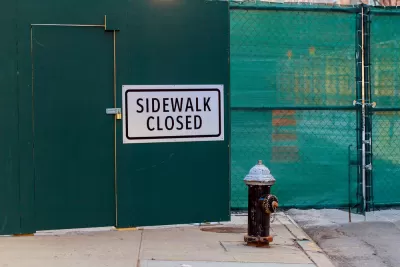
This fall, Denver voters will consider a $937 million infrastructure bond that would include $30 million to improve sidewalks near light rail stations, bus stops, and bikeshare stations.
As TransitCenter's The Connection points out, the Sidewalks to Transit program won't produce nearly enough money to fix the problem—that would take more like $475 million, given that 37 percent of Denver sidewalks near transit are "either missing or too narrow to walk on comfortably."
But, combined with small quick fixes, it could be a good start to addressing a problem that The Connection says many cities don't pay enough mind: "Because most riders in high ridership systems walk to catch buses and trains, transit stops must be supported by well-designed streets and sidewalks ... Yet many cities in America have built streets without sidewalks, or allowed property owners to encroach on or neglect them."
Only two other cities—Nashville and Los Angeles—explicitly fund "walking to transit" programs, the blog notes.
Read the full story: Denver's (Side)walks to Transit

Denver to Shift Sidewalk Repair Work to City, Funded by Property Owners
The city is shifting from a piecemeal approach to sidewalk repairs that charged property owners with doing the work to a more streamlined, city-led process.
Denver Takes on Sidewalk Repair
The Colorado capital is the largest U.S. city to commit to maintaining its entire sidewalk network, funding repairs through a fee on property owners.
Denver mayor announces 'Mile High Line' vision for interconnected bike and transit routes
The mayor emphasized building more housing near transit lines and bike paths, but failed to address planned transit service cuts.

Planetizen Federal Action Tracker
A weekly monitor of how Trump’s orders and actions are impacting planners and planning in America.

California plans to bury El Niño’s downpour
If the state plays its cards right, it may be able to store a billion acre-feet of El Niño’s water in aquifers.

Chicago breaks ground on $3 billion megadevelopment
The new neighborhood, titled Foundry Park, will one day host 3,700 residences.

Satanic place names
From streams and lakes to valleys and canyons, I mapped more than 1,000 places named after the Devil.

California High-Speed Rail Authority CEO resigns after $600,000 scandal
Under Ian Choudri, the authority used taxpayer dollars to fund first class flights and trips to nightclubs.

Want to study the Missouri River? Soon, you may need unanimous approval from 10 states
Legislation would require 10 governors’ permission to study or build projects moving water outside the basin.

FREE Course: Walkable City 1: Why Walkability?
After describing his path towards focusing on walkability as the essence of good planning, Jeff Speck marches through his five principal reasons for making more walkable places.
Reinventing Malls: Planning Alchemy—Turning Gray Fields Into Gold
The course focuses on the opportunities and imperatives that shape reinvention of mall sites.

City of Rosemead
Rutgers University, Edward J. Bloustein School of Planning and Public Policy
One Hundred Miles
Hunter College, City University of New York (CUNY)
The Architects Foundation
University of Cincinnati Online
City of Cambridge
Montrose County
The Pocatello Development Authority