When Ford GoBike took over Bay Area Bike Share last year and promised to expand the number of bikes ten-fold, they entered into an exclusivity contract with San Francisco. So why is the city going to issue a permit to a competitor?


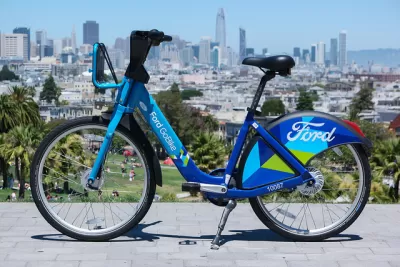
"San Francisco’s transportation agency is preparing to issue its first permit to a competitor of Ford GoBike, potentially threatening a contract between the Bay Area and the $65 billion Ford Motor Company," reports Joe Fitzgerald Rodriguez for the San Francisco Examiner on October 10, 2017.
JUMP, a division of Brooklyn-based Social Bicycles or SoBi, "could offer as many as 1,000 bikes to San Franciscans to rent should the permit be finalized."
But that permit allegedly runs afoul of an exclusivity contract Ford entered into with The City, along with its administrator of the bikeshare program, Motivate [also Brooklyn-based].
Ford GoBike is regional, with locations in San Jose and the East Bay cities of Oakland, Emeryville and Berkeley, as well as San Francisco, which partly explains the intervention of the Bay Area's regional planning agency.
Though no entity has formally sued another, the possible threat of legal action from Motivate and Ford has allegedly driven the Metropolitan Transportation Commission to begin a “dispute resolution process” between the San Francisco Municipal Transportation Agency (SFMTA) and Bay Area Motivate LLC, according to sources with knowledge of the situation.
JUMP's entrance into San Francisco has academic roots
"The limited rollout is part of a UC Berkeley study to see how people choose their mode of transportation, funded by a $735,000 grant from the Federal Highway Administration," reports Laura Wenus for Mission Local on June 27.
JUMP bikes are in their early days, and this week’s rollout is a modest 100-bike endeavor that isn’t yet open to the public, though that is a goal for the future. Instead, Social Bicycles staff have been reaching out to local businesses and nonprofits to offer memberships to people living and working in places where the program is starting out.
The cost is seven-cents per minute, just over $1 per 15 minutes, and that's important to the study, which is about mode choice and pricing.
It would appear that SMTA opened the door to this conflict when they passed new regulations, authored by Supervisor Aaron Peskin, last March for bikeshare services that don't use docking stations, adds Rodriguez of The Examiner. JUMP applied for a permit under those new regulations.
Why did SFMTA approve these regulations? They were worried about an invasion of dockless bikes from China-based Bluegogo bikes, reported Rodriguez last January (posted here).
FULL STORY: Brewing bikeshare battle may threaten SF’s Ford GoBike contract

San Diego Merchants Call for Halt to Dockless Bikeshare Operations
Public bikeshare arrived in San Diego in 2014. Last month, three companies unleashed thousands of dockless bikes, cluttering sidewalks in three business districts to the chagrin of merchants who want a time-out so the city can develop regulations.
Bay Area Bike Share Renamed for New Sponsor: An Auto Company
The new, Detroit-based sponsor will help pay for a ten-fold expansion of the Bay Area's regional bike share program coming this spring and a new Palo Alto program. Low income residents will be offered discounted rates to join Bay Area Bike Share.

Bad Break for Scooter Rental Company in its Hometown
Years before there was e-scooter-share, there was electric (Vespa-like) scooter-share in San Francisco by start-up Scoot. Now that they are ready to launch electric bikeshare, the city won't let them, unlike Barcelona, Spain where it began service.

The state-sanctioned urbicide of Austin
People don’t kill cities. Freeways do.

US to reduce Colorado River water deliveries to Mexico
A new Colorado Treaty amendment reduces Mexico’s Colorado River water allocation by 250,000 acre feet.

New Jersey’s second-largest city bans standalone data centers
Jersey City will continue to allow co-location facilities, such as those meant for research institutions that store their own data.

Amtrak not solely to blame for New Jersey commuter rail's unreliability, report finds
A new study from the Garden State Initiative found that NJ Transit’s budget grew 20% across a 4 year period, but reliability declined significantly over the same period.

EPA erases limits on planet-warming pollution from power plants
Under Monday’s plan, power plants would still have some limits on how much mercury, arsenic and other contaminants they can emit.

Phoenix announces new on-demand transit service, more frequent RAPID buses
Both new services will launch in October, and are part of Phoenix's Project Effective Access Solutions for Easing Congestion.

FREE Course: Walkable City 1: Why Walkability?
After describing his path towards focusing on walkability as the essence of good planning, Jeff Speck marches through his five principal reasons for making more walkable places.
Reinventing Malls: Planning Alchemy—Turning Gray Fields Into Gold
The course focuses on the opportunities and imperatives that shape reinvention of mall sites.

Eagle County Government
Harvard University Graduate School of Design
Nashville Planning Department
The Architects Foundation
University of Cincinnati Online
The Pocatello Development Authority
The Urban Renewal Agency of the City of Pocatello
Journal of the American Planning Association