Gov. Andrew Cuomo was not an early endorser of congestion pricing. Why the sudden embrace, particularly when Mayor Bill de Blasio is opposed? Turns out that electronic tolling technology, embraced by the MTA, appears to have moved the governor.


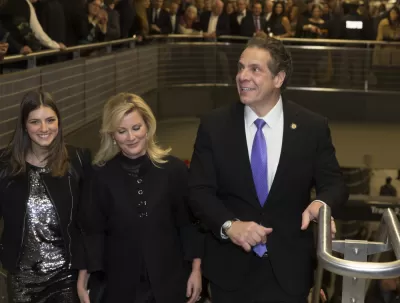
[Updated September 6, 2017] Gov. Andrew Cuomo, who celebrated the opening of a new Hudson River bridge named for his late father on Friday, is now tackling four New York City bridges. Rather than rebuilding them, as he did the long-decaying Tappan Zee Bridge between Westchester and Rockland Counties over the Hudson River, he is presumably considering adding tolls to the free East River bridges, an essential part of congestion or cordon pricing plan for New York City that he has yet to put forth. However, he has a formidable opponent in the mayor.
"As debate about creating a toll system to limit traffic in the most congested parts of Manhattan heats up, a transformation in technology could make congestion pricing a far more realistic notion than when it was last proposed a decade ago," reports Marc Santora for The New York Times.
By the end of the year, nine crossings around the city will employ an open-road, cashless collection system that does away with toll booths, toll lanes and toll collectors. Instead, sensors and cameras installed both above the road and in the pavement itself will capture cars and trucks [by photographing their license plates] as they zip by at full speed – automatically charging the 90 percent of drivers with E-ZPass transponders, and billing the other 10 percent by mail.
"Open road tolling streamlines commutes, reduces inconvenience, and, along with bolstered security measures and new LED lighting and art, reimagines New York's crossings as part of our infrastructure overhaul to meet the needs of current and future generations of New Yorkers," stated Governor Cuomo in the Metropolitan Transportation Authority (MTA) press release last December about the conversion to electronic toll collection (ETC). "This project is a transformative investment in our future that revolutionizes statewide transportation and helps us build a new New York."
"Under the old system, about 250 vehicles could pass through the E-ZPass booths per hour; about 850 cars can zip through the new system in the same amount of time," adds Santora
The Golden Gate Bridge dismantled its last toll booth a year ago to complete implementation of "a $3.2 million all-electronic collection system," reported Megan Hansen for the Marin Independent Journal on March 27, 2013. Motorists who lack FasTrak transponders pay $7.75, while those with the transponder pay a dollar less for the inbound toll.
Motorists without transponders will pay a much greater toll in New York than those using E-ZPass. For example, crossing the Verrazano-Narrows Bridge between Brooklyn and Staten Island, the toll-by-mail is $17 vs. $11.52 with E-ZPass. Crossing from the Bronx to Manhattan on the Henry Hudson Bridge, it's $6.00 vs. $2.64.
In the New York metro region, only MTA is proceeding with the conversion to cashless tolling. Crossings controlled by the Port Authority of New York and New Jersey will continue to accept cash due to resistance from NJ Gov. Chris Christie.
If Cuomo adopts the Move NY congestion (cordon) pricing plan, overhead toll gantries would be placed in Manhattan across 60th Street to toll southbound motorists.
Revenue from the plan would be used to boost transit service. Mayor Bill de Blasio opposes the plan, favoring an income tax approach to fund public transit.
[Updated to reflect the correct date for the removal of the Golden Gate Bridge toll booths.
FULL STORY: Open-Road Tolls Could Pave the Way for Manhattan Congestion Pricing

Big Push for Congestion Pricing Expected Early Next Year in New York
Ten years after former NYC Mayor Michael Bloomberg's congestion pricing plan died on the state Assembly floor, expect to see a similar plan revived by Gov. Andrew Cuomo (D-N.Y.). New York Times metro reporter, Winnie Hu, explains why it never died.

Op-Ed: Congestion Pricing Offers New York a 'Promising Path Forwards'
New York State Budget Director Robert Mujica penned a Sunday op-ed for the Daily News on the benefits of congestion pricing. On Tuesday, Gov. Cuomo broke the news on WNYC that he and Mayor de Blasio agreed on tolling the central business district.
New York City Congestion Pricing Plan Ready for Review
Motorists and truckers would pay tolls to drive south of 60th Street in Manhattan while passengers in taxis and ride-hailing vehicles would pay a surcharge under a plan released Friday by the Fix NYC panel convened by Gov. Cuomo in October.

The state-sanctioned urbicide of Austin
People don’t kill cities. Freeways do.

US to reduce Colorado River water deliveries to Mexico
A new Colorado Treaty amendment reduces Mexico’s Colorado River water allocation by 250,000 acre feet.

New Jersey’s second-largest city bans standalone data centers
Jersey City will continue to allow co-location facilities, such as those meant for research institutions that store their own data.

Amtrak not solely to blame for New Jersey commuter rail's unreliability, report finds
A new study from the Garden State Initiative found that NJ Transit’s budget grew 20% across a 4 year period, but reliability declined significantly over the same period.

EPA erases limits on planet-warming pollution from power plants
Under Monday’s plan, power plants would still have some limits on how much mercury, arsenic and other contaminants they can emit.

Phoenix announces new on-demand transit service, more frequent RAPID buses
Both new services will launch in October, and are part of Phoenix's Project Effective Access Solutions for Easing Congestion.

FREE Course: Walkable City 1: Why Walkability?
After describing his path towards focusing on walkability as the essence of good planning, Jeff Speck marches through his five principal reasons for making more walkable places.
Reinventing Malls: Planning Alchemy—Turning Gray Fields Into Gold
The course focuses on the opportunities and imperatives that shape reinvention of mall sites.

Eagle County Government
Harvard University Graduate School of Design
Nashville Planning Department
The Architects Foundation
University of Cincinnati Online
The Pocatello Development Authority
The Urban Renewal Agency of the City of Pocatello
Journal of the American Planning Association