New transit lines are usually intended to provide an alternative to driving. But what happens when a new train line provides an alternative to an older train line?


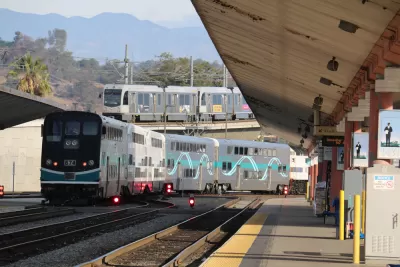
Thousands of Southern California transit users are switching from Metrolink commuter rail to Gold Line light rail, according to an article by Steve Scauzillo. "Both go to Los Angeles but the Gold Line is much cheaper, offers more trains more often and less waiting," according to Scauzillo.
According to a ridership released by Metrolink in July, ridership on the agency's San Bernardino line dropped 7.6 percent between January and March compared to the year prior. In total, the line lost 56,620 riders. Other lines also lost riders numbering in the tens of thousands.
When rail commuters hop from one train service to another, the switch "doesn’t remove cars from the traffic-snarled freeways nor does it reduce air pollution since these commuters weren’t driving anyway." It is, however, creating friction between Metrolink and Metro, which will "only get worse once the Foothill Gold Line Construction Authority builds the next leg from Glendora to Montclair, creating duplication of services at three Metrolink stations: Montclair, Pomona and Claremont," writes Scauzillo.
In response to the conflicting dynamics of the two transit agencies, "heavy rail planners at the Los Angeles County Metropolitan Transportation Authority, or Metro, [have] proposed a $500,000 study on how the two agencies can coexist."
Read the full story: A tug-of-war between Metro, Metrolink intensifies as thousands switch to cheaper Gold Line
Rail Redundancy Shouldn't Be Self-Destructive
Los Angeles Metro's new Gold Line light rail extension is attracting riders from the regional Metrolink commuter rail line that serves San Bernardino. The editorial board of the Daily Bulletin suggests that's not necessarily a problem.
12.3-Mile Gold Line Extension Takes First, Tentative Steps in Southern California
One step forward, and maybe two steps back, for a 12.3-mile extension of the Gold Line light rail in the San Gabriel Valley.
SoCal's Gold Line Extension Delayed Two Years
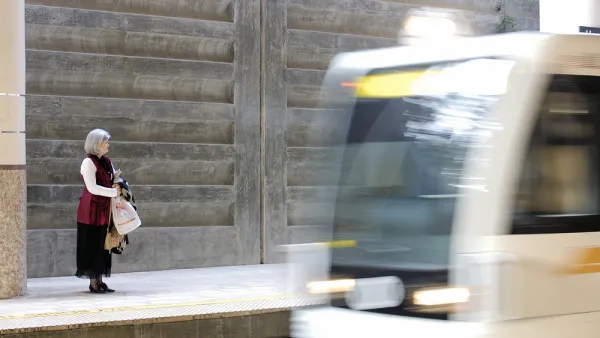
The Los Angeles County Metropolitan Transportation Authority's (Metro) planned Gold Line extension is now scheduled to finish construction in 2025.

Desperate measures: Advocates weigh draining Lake Powell to fill Colorado River
Draining the reservoir could reduce evaporation losses by a couple hundred thousand acre-feet.

Eastern Nebraska is running out of electricity
Data centers and electrification are straining eastern Nebraska’s grid, throttling economic development.

Move over, LA: St. Louis gears up for Olympics, invests millions in downtown redevelopment
The Missouri city will host the 2028 Olympic soccer group stage and knockout matches.

Mass. votes against statewide minimum lot size for single-family homes
Over 2 million residents voted on Question 7; it was decided by just over 30,000 votes.

Maryland’s $15 billion bridge project gains key approval
The Maryland Transit Authority said the project will create over 60,000 jobs and add $23 billion to the local economy.

‘No clear next steps’ for Chicago's permanent festival grounds
Eleventh Ward Ald. Nicole Lee has suggested Soldier Field as a possible location for the permanent event space.

FREE Course: Walkable City 1: Why Walkability?
After describing his path towards focusing on walkability as the essence of good planning, Jeff Speck marches through his five principal reasons for making more walkable places.
Reinventing Malls: Planning Alchemy—Turning Gray Fields Into Gold
The course focuses on the opportunities and imperatives that shape reinvention of mall sites.

City of Rosemead
Rutgers University, Edward J. Bloustein School of Planning and Public Policy
One Hundred Miles
University of Michigan School for Environment and Sustainability (SEAS)
Hunter College, City University of New York (CUNY)
The Architects Foundation
City of Cambridge
The Pocatello Development Authority
The Urban Renewal Agency of the City of Pocatello