The question of whether self-driving cars will make streets and roads a safer place for humans depends on whether technology can protect the most vulnerable users.


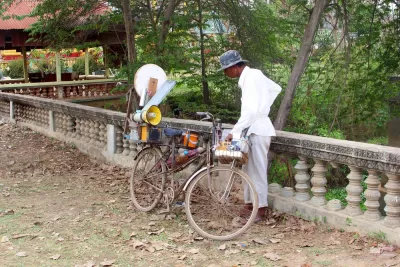
Margaret J. Krauss writes: "Proponents of self-driving cars say they'll make the world safer, but autonomous vehicles need to predict what bicyclists are going to do. Now researchers say part of the answer is to have bikes feed information to cars."
Krauss refers to research underway by Waymo, "the self-driving car company that began life in 2009 as a Google project," and shares insight from the millions of miles of self-driving experiments already logged by the team led by Waymo's principal software engineer, National Fairfield. "By tracking a flock of cyclists, Waymo's cars were learning how bikes move through the world," explains Krauss. "But that's not enough." Self-driving cars also need to predict what bikes are going to do next, according to Fairfield.
Krauss also examines the work of Uber's self-driving cars tests in Pittsburgh. Anthony Rowe, an associate engineering professor at Carnegie Mellon University, describes work in that city to outfit bikes with technology that could someday be installed on a smartphone to work in concert with a world of self-driving cars.
Read the full story: Bikes May Have To Talk To Self-Driving Cars For Safety's Sake
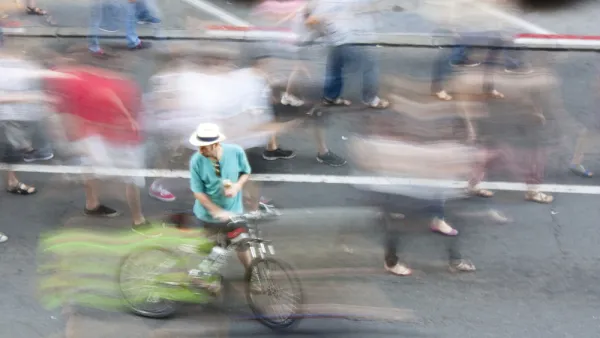
The Bicyclists' Manifesto for an Autonomous Vehicle Future
"Policy goals" won't be enough to protect bicyclists once the cars start driving themselves. Strong standards will be necessary to govern the interactions between cars and bikes in an autonomous future.
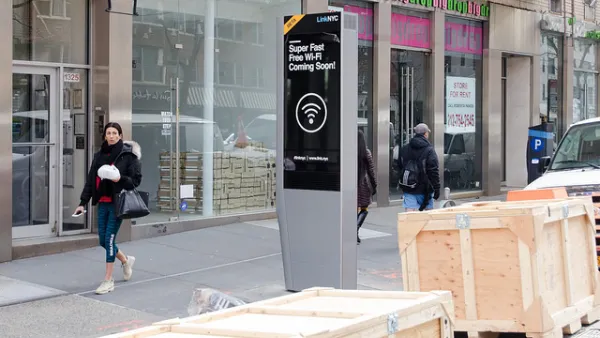
Sidewalk Labs and Transportation For America to Develop Connected Streets
Sidewalk Labs has teamed up with Transportation for America in the hopes of better connecting transportation technology with desired transportation outcomes.
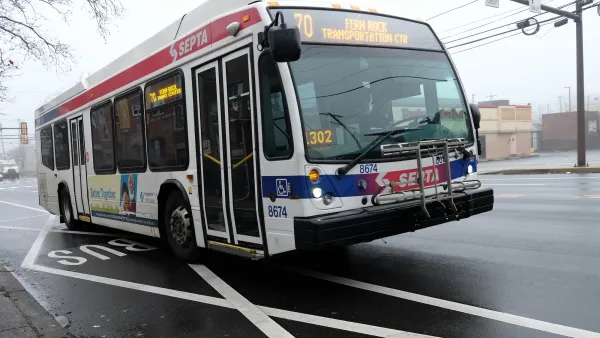
Pennsylvania lawmaker wants to ban fully self-driving buses
State Rep. Ben Waxman's proposed bill would require autonomous buses to have a licensed driver on board.

Planetizen Federal Action Tracker
A weekly monitor of how Trump’s orders and actions are impacting planners and planning in America.

California plans to bury El Niño’s downpour
If the state plays its cards right, it may be able to store a billion acre-feet of El Niño’s water in aquifers.

Desperate measures: Advocates weigh draining Lake Powell to fill Colorado River
Draining the reservoir could reduce evaporation losses by a couple hundred thousand acre-feet.

Los Angeles just elected an urban planner as its mayor
Transportation analysts are optimistic that Raman will be more aggressive in addressing transit issues than Bass.

Mamdani’s pied-à-terre tax survives legal challenge
A panel of judges found that the plaintiffs failed to demonstrate injury as a result of New York City's implementation of the tax.

Eastern Nebraska is running out of electricity
Data centers and electrification are straining eastern Nebraska’s grid, throttling economic development.

FREE Course: Walkable City 1: Why Walkability?
After describing his path towards focusing on walkability as the essence of good planning, Jeff Speck marches through his five principal reasons for making more walkable places.
Reinventing Malls: Planning Alchemy—Turning Gray Fields Into Gold
The course focuses on the opportunities and imperatives that shape reinvention of mall sites.

City of Rosemead
Rutgers University, Edward J. Bloustein School of Planning and Public Policy
One Hundred Miles
University of Michigan School for Environment and Sustainability (SEAS)
Hunter College, City University of New York (CUNY)
The Architects Foundation
City of Cambridge
Montrose County
The Pocatello Development Authority