Another study shows what should be obvious by now: the higher quality the bike infrastructure, the better the results in terms of safety and mode choice.


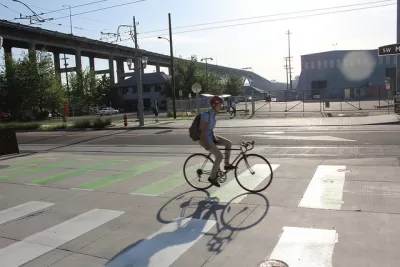
"A new study [pdf] published in the American Journal of Public Health has concluded that physical separation from motor traffic is “crucial” to reducing the higher than average cyclist injury rates seen across the U.S.," reports Mark Sutton.
The study collected evidence from Europe, ten cities and the United States, and an earlier study of Boston.
An editorial that accompanies the study [pdf] also states the following about the effect of infrastructure quality on safety outcomes:
It is crucial to provide physical separation from fast-moving, high-volume motor vehicle traffic and better intersection design to avoid conflicts between cyclists and motor vehicles. More and better bicycle infrastructure and safer cycling would encourage Americans to make more of their daily trips by bicycle and, thus, help raise the currently low physical activity levels of the US population.
The study's exhibit A is provided by Minneapolis, where the city "grew its cycle network by 113% between 2000 and 2015, delivering a 79% reduction in severe injuries per 100,000 cycle journeys," explains Sutton. "This also tallied with a 203% growth in cycling in the areas where safe infrastructure was present."
Read the full story: Safer Cycling Through Improved Infrastructure [pdf]
New Evidence of the Superiority of Bike Lanes Over Sharrows
A study presented last week to the Transportation Research Board shows that the quality of the bike infrastructure has a significant effect for commuting rates and safety.

Study: When Women Ride Bikes, Everyone Rides More
New research indicates a positive association between overall cycling levels and ridership rates for women-identified riders.
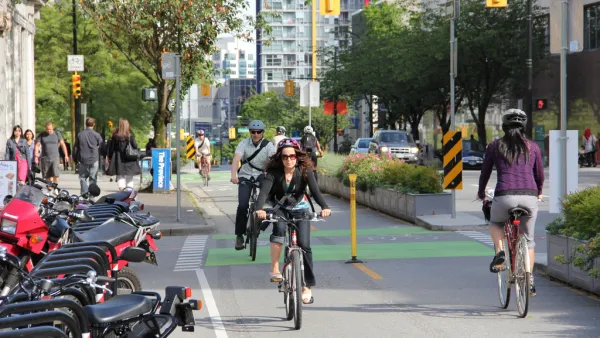
Study: More Bike Infrastructure Leads to More Bike Riders
File under "build it and they will come."

Planetizen Federal Action Tracker
A weekly monitor of how Trump’s orders and actions are impacting planners and planning in America.

Eastern Nebraska is running out of electricity
Data centers and electrification are straining eastern Nebraska’s grid, throttling economic development.

Move over, LA: St. Louis gears up for Olympics, invests millions in downtown redevelopment
The Missouri city will host the 2028 Olympic soccer group stage and knockout matches.

Dallas releases zoning code overhaul to officials
The drafted overhaul is over 400 pages long.

NYC renovations for dangerous, ‘mercilessly crammed’ street delayed until 2027
Construction was supposed to begin this fall.

San Diego’s Midway Rising project gets greenlight from city council
The project looks to become the largest affordable housing development in California's history.

FREE Course: Walkable City 1: Why Walkability?
After describing his path towards focusing on walkability as the essence of good planning, Jeff Speck marches through his five principal reasons for making more walkable places.
Reinventing Malls: Planning Alchemy—Turning Gray Fields Into Gold
The course focuses on the opportunities and imperatives that shape reinvention of mall sites.

City of Rosemead
Rutgers University, Edward J. Bloustein School of Planning and Public Policy
One Hundred Miles
University of Michigan School for Environment and Sustainability (SEAS)
Hunter College, City University of New York (CUNY)
The Architects Foundation
City of Cambridge
The Pocatello Development Authority
The Urban Renewal Agency of the City of Pocatello