The U.S. EPA has signaled that it will withdraw an earlier decision to maintain the 54.5 miles per gallon target. Should that happen, a major casualty will be electric vehicles, according to one prominent EV advocate interviewed on NPR.


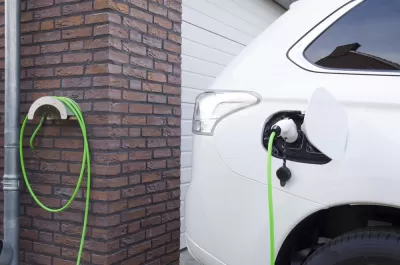
Electric vehicle advocate Chelsea Sexton, co-founder and former executive director of Plug In America, warns that electric vehicle sales are already vulnerable even without the predicted regulation change by the U.S. Environmental Protection Agency and U.S. Department of Transportation. They "are still heavily dependent on external regulation," she tells Sonari Glinton, NPR business correspondent [audio available].
Sexton, known for her role in the 2006 documentary, Who Killed the Electric Car?, agrees with Glinton's assessment of the auto industry's preference for larger, conventional vehicles.
When Chevy makes a Silverado, they make thousands of dollars. When they make a Chevy Volt, they lose money.
"And in fact, even some of the more aggressive automakers are likely to roll back their [EV] plans," adds Sexton.
Glinton makes one notable exception: auto manufacturer Tesla. Unlike many other EVs on the road in California, which has a rigorous zero emission vehicle requirement, Teslas are not 'compliance vehicles.'
Relaxing federal fuel efficiency standards
The Natural Resources Defense Council's energy and transportation director, Roland Hwang, tells Glinton that the E.P.A. has to go through a formal process to relax the fuel efficiency standards.
They have to notify, allow public comment before they actually issue a decision. And then we'll see them in court.
[Coral Davenport of The New York Times explained the process: "After withdrawing the Obama administration’s requirement for model years 2022 through 2025, the Trump administration will have a year to put forth an alternative set of efficiency standards.]
"Reversing the E.P.A. and the Department of Transportation rules could take as long as two years," adds Glinton. "Hwang says walking back the rules will have unintended consequences."
And frankly, what it's going to do is it's going to throw the auto industry into chaos. To unwind these standards will be a years-long battle in the courts.
Glinton ends his report on a hopeful note for EV enthusiasts, but not on a federal level. Perhaps no state has embraced electric vehicles as California has done under Gov. Jerry Brown and the state's Air Resources Board under the leadership of Mary Nichols, which has set a target of 1.4 million zero emission vehicles on California roads by 2025. The governor set his own target of 1.5 million ZEVS by that date.
However, even those goals may be imperiled if EPA Administrator Scott Pruitt withdraws a waiver that allows the state to set its own emissions standards.
Read the full story: How Administration Regs Could Affect The Future Of The Electric Car

California Earning Clean Air Despite the U.S. Environmental Protection Agency
While premature to claim victory, a report from the San Francisco Chronicle suggests that the California Air Resources Board will prevail in a looming showdown with the U.S. EPA over whether to allow the state to set vehicle emission standards.
Nancy Pelosi Not the Only Powerful California Woman Disrupting the Trump Administration
No issue is more important to California's air and climate regulators than ensuring that the state retains its ability to set tailpipe emission standards. Mary Nichols, the head of the Air Resources Board, has threatened to ban tailpipes.
Trump Administration Proposes to Freeze Fuel Economy Standards at 2020 Level
On Thursday, the U.S. DOT and U.S. EPA announced one of the Trump administration's most consequential rollbacks of environmental and efficiency regulations that will have a detrimental effect on climate change, air pollution, and oil consumption.

Planetizen Federal Action Tracker
A weekly monitor of how Trump’s orders and actions are impacting planners and planning in America.

California plans to bury El Niño’s downpour
If the state plays its cards right, it may be able to store a billion acre-feet of El Niño’s water in aquifers.

Chicago breaks ground on $3 billion megadevelopment
The new neighborhood, titled Foundry Park, will one day host 3,700 residences.

California High-Speed Rail Authority CEO resigns after $600,000 scandal
Under Ian Choudri, the authority used taxpayer dollars to fund first class flights and trips to nightclubs.

Want to study the Missouri River? Soon, you may need unanimous approval from 10 states
Legislation would require 10 governors’ permission to study or build projects moving water outside the basin.

Desperate measures: Advocates weigh draining Lake Powell to fill Colorado River
Draining the reservoir could reduce evaporation losses by a couple hundred thousand acre-feet.

FREE Course: Walkable City 1: Why Walkability?
After describing his path towards focusing on walkability as the essence of good planning, Jeff Speck marches through his five principal reasons for making more walkable places.
Reinventing Malls: Planning Alchemy—Turning Gray Fields Into Gold
The course focuses on the opportunities and imperatives that shape reinvention of mall sites.

City of Rosemead
Rutgers University, Edward J. Bloustein School of Planning and Public Policy
One Hundred Miles
Hunter College, City University of New York (CUNY)
The Architects Foundation
University of Cincinnati Online
City of Cambridge
Montrose County
The Pocatello Development Authority