California's GOP congressional delegation has written the U.S. DOT asking them to delay a vital $647 million grant needed to electrify the 55-mile, San Francisco-to-San Jose commuter line on which 92 diesel-powered commuter trains operate daily.


Caltrain ridership has soared over 83 percent since 2010 to over 62,000 daily passengers, and now peak-hour trains often operate standing-room only. In addition to eliminating toxic diesel emissions [PDF], electrification would "upgrade the performance, operating efficiency, capacity, safety and reliability of Caltrain's commuter rail service," according to Caltrain.
"Caltrain spokeswoman Tasha Bartholomew says the [federal] funds are needed by March 1," reports Katy Murphy for The Mercury News "Otherwise, she said, it 'would result in delays that could threaten the viability of the electrification project.'”
As a contender for the $647 million federal grant, the Caltrain project underwent a two-year review, receiving 'medium-high ratings' from the Federal Transit Administration. It now needs the signature of the new Secretary of Transportation Elaine Chao — typically a pro-forma step done after a 30-day comment period, which ends in mid-February.
The remaining funds for the $2 billion project, which also includes installation of federally mandated positive train control, have been allocated through an historic 2012 regional agreement brokered by the Metropolitan Transportation Commission, with San Mateo County just last month agreeing to assign an additional $135 million after federal transportation officials insisted those overseeing the project prove they could afford to finish even if construction costs increase. The agreement included the California High-Speed Rail Authority allocating $706 million from the nearly $10 billion, 2008 Proposition 1A bond monies.
It is that connection to high-speed rail that has spurred the congressional Republican to target the Caltrain project, although the two are independent, though clearly related to each other. However, that distinction is egregiously lacking in their letter.
"Asked why California’s own representatives would try to block funding from the state, Congressman Tom McClintock, R-Roseville, responded with an email about high-speed rail, not the Caltrain project," writes Murphy.
Similarly, the Jan. 24 state Republican delegation's letter [PDF] to Secretary Chao, signed by McClintock, Majority Leader Kevin McCarthy (Bakersfield), and Rep. Jeff Denham (Turlock), chair of the rail subcommittee of the House Transportation and Infrastructure Committee, and 11 other congress members fails to even mention Caltrain by name. It appears the letter assumes, wrongly, that the California High-Speed Rail Authority is requesting the grant. The closest it comes to mentioning Caltrain is this paragraph:
We have learned that the Authority is pursuing a Railroad Rehabilitation and Improvement Financing package to fill funding holes from its inability to secure State or private funds, and is seeking an additional $650 million in grants from the federal government to electrify its line from San Jose to San Francisco for use by both transit and high-speed rail service.
The letter is also wrong about who owns the "line from San Jose to San Francisco." It was purchased by the Peninsula Corridor Joint Powers Board from Southern Pacific Railroad in December 1991. See BayRail Alliance's excellent chronology on Caltrain history, dating back to 1851.
As Rep. Anna Eshoo, D-Palo Alto, told the San Mateo Daily Journal, “It was stunning to me because there were inaccuracies in their letter and I thought it was very important that Secretary Chao get the real facts,” Eshoo said.
“It’s very important to the state. [Caltrain] is not a Republican transportation system nor is it a Democrat transportation system; it is the spine of our transportation system on the Peninsula.”
The 39-member Democratic congressional delegation's letter of Feb. 3 to Secretary Chao on the Caltrain application for the federal grant can be accessed on Eshoo's webpage.
The Republican delegation's letter "also cites a risk analysis by the Federal Railroad Administration projected [sic] a potential $3.5-billion increase in cost for the first segment of the project from Merced to Shafter," writes Ralph Vartabedian for the Los Angeles Times. "The analysis was made public last month by The Times."
First test of Transportation Secretary Chao
The Mercury News editorial board, which opposes the state high-speed rail project, but supports Caltrain electrification, wrote:
The secretary, with barely time to settle into the job, is on the spot. Failing to sign off on the grant by March 1 will kill it. She seems to be the least controversial, most widely respected cabinet appointees in the new administration, and this could be the first test of her independence and judgment.
===================================================================================
Correspondent's notes:
- In addition to the weekday schedule, Caltrain runs hourly, local service from 7 a.m. or 8 a.m. to 10 p.m. or midnight on weekends, plus two express trains in each direction, between San Jose and San Francisco.
- Interested readers can sign petition on TransForm website to send to Secretary Chao.
Hat tip to Loren Spiekerman.
Read the full story: Political battle threatens to halt Caltrain electrification project

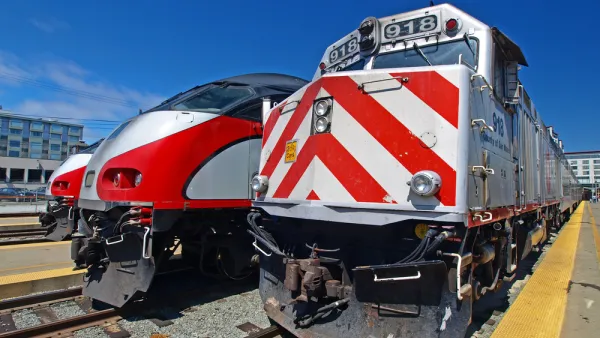
Trump's California Double Play: Potential Fatal Blow to Commuter and High-Speed Rail
In one of her first major decisions, Transportation Secretary Elaine Chao deferred a decision on a critical $647 million federal grant to electrify the 51-mile San Francisco to San Jose Caltrain line, which would also be used by high-speed rail.
Caltrain Electrification Broke Ground on Friday
Gov. Jerry Brown, Peninsula congresswomen, including House Minority Leader Nancy Pelosi, and state legislative leaders gathered in Millbrae with shovels-in hands to mark the beginning of a four-year construction project to electrify Caltrain.
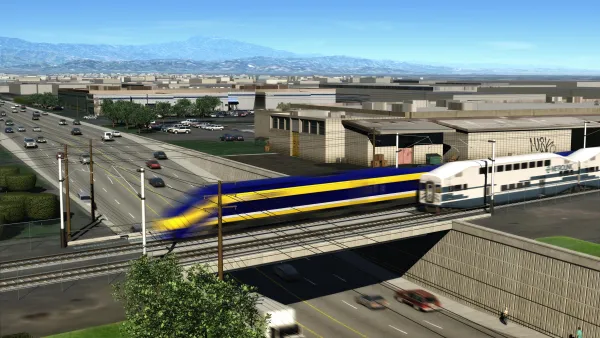
More Fallout From Downsizing California High-Speed Rail
A San Francisco Chronicle editorial warns that San Francisco must find funds, intended to come from the state's ambitious rail project, to extend the Caltrain commuter rail line to the SalesForce Transit Center.

Planetizen Federal Action Tracker
A weekly monitor of how Trump’s orders and actions are impacting planners and planning in America.

Northwest rail fans eager for Sept. 30 debut of Amtrak’s Airo fleet
Get ready for that new train smell and more seats. But they won’t go faster or run more frequently on the Cascades route in Washington and Oregon.

Trump is considering data centers on 6 states' public land — some state officials say they had no idea
If the administration approves the proposed projects, data center and data center-related developments will cover 17,600 acres of public land.

After decades of planning, Sacramento gains new light rail station
Trains will arrive every 15 minutes during peak hours and every 30 minutes during non-peak hours.

Massive tunnel-boring machine breaks ground on Gateway Project
The Trump administration revoked funding for the project in October 2025, and then restored it earlier this year.

Airo trainsets begin service on Amtrak Cascades route
The trains feature panoramic windows, complementary wifi and over 300 seats per train set.

FREE Course: Walkable City 1: Why Walkability?
After describing his path towards focusing on walkability as the essence of good planning, Jeff Speck marches through his five principal reasons for making more walkable places.
Reinventing Malls: Planning Alchemy—Turning Gray Fields Into Gold
The course focuses on the opportunities and imperatives that shape reinvention of mall sites.

City of Thousand Oaks
City of Wisconsin Rapids
Harvard University Graduate School of Design
The Architects Foundation
University of Cincinnati Online
Northern Illinois Transit Authority (NITA)
The Pocatello Development Authority
The Urban Renewal Agency of the City of Pocatello