Fulfilling two campaign promises, President Trump conditionally approved two controversial pipelines to transport oil sands from Alberta and Bakken oil from North Dakota, certain to stir opposition from environmentalists and Native Americans.


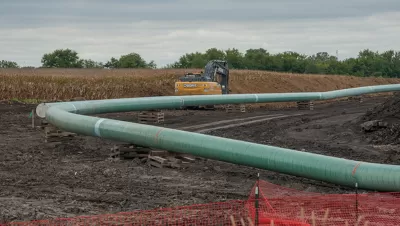
At a signing ceremony on Tuesday, President Trump reversed former President Obama's rejection of the controversial Keystone XL pipeline, though he "emphasized that the construction isn't a done deal, reported Gregory Korte, for USA TODAY. "It's something that subject to a renegotiation of terms by us," he said. "We'll see if we can get the pipeline built."
Similarly, Trump signed an action that revives the controversial Dakota Access Pipeline that was halted last month by the Army Corps of Engineers.
The "executive memorandum direct(s) the Army 'to review and approve in an expedited manner the pipeline, 'to the extent permitted by law and as warranted," report Peter Baker and Coral Davenport for The New York Times. "In his session with reporters, he added, 'Again, subject to terms and conditions to be negotiated by us.'”
Reaction from the environmental community is swift.
"Donald Trump has been in office for four days and he’s already proving to be the dangerous threat to our climate we feared he would be," stated Michael Brune, executive director of the Sierra Club. "But, these pipelines are far from being in the clear."
Two additional directives expedite the "process of approving and regulating future pipeline and infrastructure projects," adds Korte.
The first was about streamlining the permitting process and reducing the regulatory process "for domestic manufacturing," Trump said. It wasn't clear to this correspondent if this action was directed at pipeline construction or more broadly to other industrial activity..
If it’s a no, we'll give them a quick no, and if it’s a yes, it's like 'Let's start building,' " [Trump] said. "The regulatory process in this country has become a tangled up mess, and very unfair to people."
Donald Trump, environmentalist.
Anticipating criticism from the environmental community, he added (per New York Times):
“I am, to a large extent, an environmentalist, I believe in it. But it’s out of control and we’re going to make it a very short process. And we’re going to either give you your permits or we’re not going to give you your permits. But you’re going to know very quickly. And generally speaking we’re going to be giving you your permits.”
The second was about expediting environmental reviews and approvals for high-priority infrastructure projects," Trump said. Presumably this action was directed at the much anticipated $1 trillion infrastructure plan he has touted but about which he has offered few details.
A fifth action specified that pipes for domestic pipelines be constructed in the United States.
"The directives Trump signed Tuesday were a mix of executive orders and presidential memoranda," points out Korte.
As of press time, none were listed on the White House website.
FULL STORY: Trump signs five more orders on pipelines, steel and environment


Trump Signs Two Executive Orders Limiting States' Authority Over Energy Pipelines
The Trump administration's "energy dominance" agenda depends, in part, on growing the energy distribution network, namely pipelines, rail facilities, and ports. However, states can use the Clean Water Act to block pipelines and coal terminals.
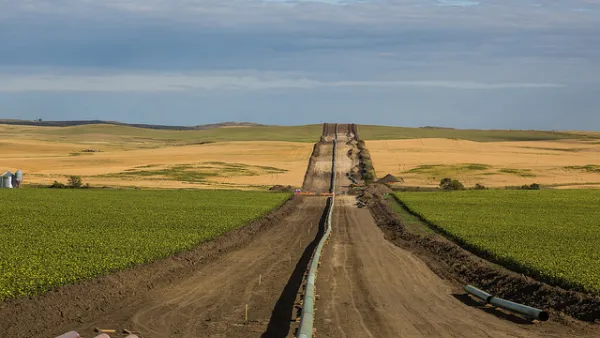
Dakota Access Pipeline Owners Win Eminent Domain Appeal in Iowa Supreme Court
The Iowa Supreme Court affirmed a lower court ruling that found that the Iowa Utilities Board was justified in giving the private owners of the Dakota Access Pipeline the use of eminent domain. Climate change was considered in the ruling.
Keystone Pipeline Leaks Oil in Advance of Crucial Decision on Sister Pipeline
Thursday's massive oil spill in South Dakota is not a good omen for TransCanada for a favorable decision on Monday on an application before the Nebraska Public Service Commission on the routing of the controversial Keystone XL pipeline.

The state-sanctioned urbicide of Austin
People don’t kill cities. Freeways do.

US to reduce Colorado River water deliveries to Mexico
A new Colorado Treaty amendment reduces Mexico’s Colorado River water allocation by 250,000 acre feet.

New Jersey’s second-largest city bans standalone data centers
Jersey City will continue to allow co-location facilities, such as those meant for research institutions that store their own data.

Amtrak not solely to blame for New Jersey commuter rail's unreliability, report finds
A new study from the Garden State Initiative found that NJ Transit’s budget grew 20% across a 4 year period, but reliability declined significantly over the same period.

EPA erases limits on planet-warming pollution from power plants
Under Monday’s plan, power plants would still have some limits on how much mercury, arsenic and other contaminants they can emit.

Phoenix announces new on-demand transit service, more frequent RAPID buses
Both new services will launch in October, and are part of Phoenix's Project Effective Access Solutions for Easing Congestion.

FREE Course: Walkable City 1: Why Walkability?
After describing his path towards focusing on walkability as the essence of good planning, Jeff Speck marches through his five principal reasons for making more walkable places.
Reinventing Malls: Planning Alchemy—Turning Gray Fields Into Gold
The course focuses on the opportunities and imperatives that shape reinvention of mall sites.

Eagle County Government
Harvard University Graduate School of Design
Nashville Planning Department
The Architects Foundation
University of Cincinnati Online
The Pocatello Development Authority
The Urban Renewal Agency of the City of Pocatello
Journal of the American Planning Association