Gabe Klein thinks a proposed ban on self-driving cars in Chicago is shortsighted.



John Greenfield recently interviewed Gabe Klein, former transportation chief of the city of Chicago and author of Start-Up City, on the subject of a proposal in Chicago to ban self-driving cars.
Meg Graham reported on the proposed ban in September, in case you missed that story. "Aldermen Ed Burke and Anthony Beale proposed the ordinance Wednesday in a City Council meeting, calling it a 'preemptive strike' after Uber’s announcement it was beginning a pilot of self-driving cars," wrote Graham at the time. The aldermen were unprepared to allow Chicago streets to conduct the "experiment" currently ongoing in Pittsburgh.
Klein's take on the proposed regulation, however, is that the current system of "people-drive cars" is unacceptable. In Klein's own words: "the idea that self-driving cars are going to be less safe is almost impossible. Human error causes 94 percent of car crashes, so the faster we can get people out from behind the wheel of [multi-ton] hunks of metal next to pedestrians and cyclists, the safer our cities will be, the more people will want to live in our cities, the safer and healthier our children will be, because they’ll start walking and biking to school again."
Klein and Greenfield discuss the potential of self-driving cars in much detail—including the role of the taxi industry in opposing self-driving cars in Chicago, the idea that autonomous vehicles will encourage sprawl, and the recently announced federal regulations for self-driving cars.
Read the full story: Ex-CDOT Chief Klein Discusses Proposed Ban on Self-Driving Cars in Chicago

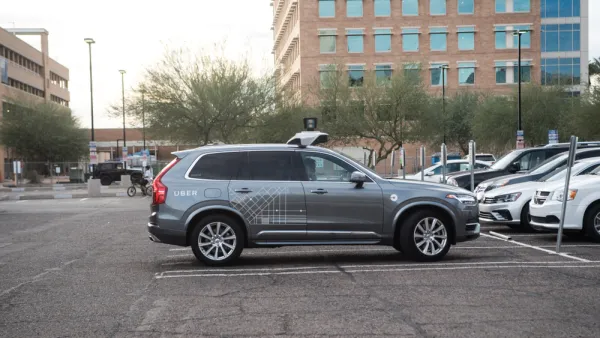
Uber Wants to Return its Autonomous Vehicles to Public Roads
The move comes almost eight months after a self-driving Uber vehicle struck and killed a pedestrian.

Uber Cuts Self-Driving Car Operators
Uber announced 100 lay offs this week.
Uber's Self-Driving Cars Leave Hometown for Warmer, and Friendlier Climates
California's loss is Arizona's gain. That's how Arizona Gov. Doug Ducey see's Uber's decision on Thursday to haul their fleet of self-driving Volvos from San Francisco to Arizona after the company refused to secure the necessary operating permits.

Planetizen Federal Action Tracker
A weekly monitor of how Trump’s orders and actions are impacting planners and planning in America.

Amtrak, CN end decades-long dispute with eight-year agreement
The new operating agreement establishes an updated framework for the companies to work together, including processes to resolve disputes.

Judges permit Denver to divert 77,000 acre feet from the Colorado River for reservoir expansion
Overuse and climate change have caused the Colorado River’s water levels to plummet.

Boston has spent millions making the Green Line more accessible — and there’s no end in sight
While the city has invested millions into expanding and adding platforms to the Green Line to make it more accessible, new train cars set to arrive next year will be too tall for disabled passengers to board without raising the current platforms.

Idaho may see an 18% drop in federal surface transit funding — the largest estimated cut in the US
Transit systems in rural communities are much more reliant on federal funding to provide their services.

How ‘post-disaster gentrification’ alters neighborhoods after natural calamities
After hurricanes, fires or other calamities, the original residents of a community are often replaced by younger, wealthier residents.

FREE Course: Walkable City 1: Why Walkability?
After describing his path towards focusing on walkability as the essence of good planning, Jeff Speck marches through his five principal reasons for making more walkable places.
Reinventing Malls: Planning Alchemy—Turning Gray Fields Into Gold
The course focuses on the opportunities and imperatives that shape reinvention of mall sites.

Harvard University Graduate School of Design
KFH Group Inc.
Greater Baltimore Committee
The Architects Foundation
University of Cincinnati Online
The Pocatello Development Authority
The Urban Renewal Agency of the City of Pocatello