A new book by a Pulitzer Prize winning journalist digs into the consequences of a society driven by the automobile.


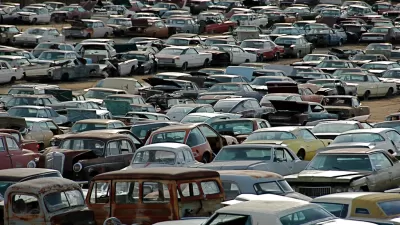
Claudia Dreifus interviews Edward Humes, author of the recently released book Door to Door: The Magnificent, Maddening, Mysterious World of Transportation.
The major theme of the interview, and the book, is the "transportation overkill" that defines American life. Here's how Humes describes that premise:
We drive these vehicles that weigh 4,000 pounds and are built to carry five people and eight suitcases, and most of the time, it’s just one person and this giant machine going to work. We’ve got transportation overkill.
Humes also reveals the inspiration for the title of the book, "Door to Door," which he says is the expectation for transportation in the United States: "Americans prefer to move door to door. They want to close one door and find themselves in front of another."
Other subjects touched on in the article include traffic safety, traffic speeds, and self-driving cars.
FULL STORY: Edward Humes on How Transportation Overkill Is Killing Us

Trump’s Backlash to EVs Is Making All Cars More Expensive — Including Ones that use Gas
Uncertainty about vehicle standards and anti-renewable energy policies are raising the cost of both buying and maintaining a car.
Car Loan Defaults Have Spiked 50%. With Repossession Rates Rising, How Will Americans Get to Work?
In 2024, 1.7 million cars were repossessed in the United States, the highest number since 2009.

Car Trips are Down, With Young People Leading the Charge
Americans are driving less, and we have Gen Z to thank for it.

Planetizen Federal Action Tracker
A weekly monitor of how Trump’s orders and actions are impacting planners and planning in America.

The state-sanctioned urbicide of Austin
People don’t kill cities. Freeways do.

US to reduce Colorado River water deliveries to Mexico
A new Colorado Treaty amendment reduces Mexico’s Colorado River water allocation by 250,000 acre feet.

Mamdani overhauls NYC's Vision Zero plan with 100 new policy goals
The overhaul aims to reduce traffic deaths and make streets safer for pedestrians, cyclists and drivers through lower speed limits, new safety infrastructure and more.

Amtrak not solely to blame for New Jersey commuter rail's unreliability, report finds
A new study from the Garden State Initiative found that NJ Transit’s budget grew 20% across a 4 year period, but reliability declined significantly over the same period.

EPA erases limits on planet-warming pollution from power plants
Under Monday’s plan, power plants would still have some limits on how much mercury, arsenic and other contaminants they can emit.

FREE Course: Walkable City 1: Why Walkability?
After describing his path towards focusing on walkability as the essence of good planning, Jeff Speck marches through his five principal reasons for making more walkable places.
Reinventing Malls: Planning Alchemy—Turning Gray Fields Into Gold
The course focuses on the opportunities and imperatives that shape reinvention of mall sites.

Eagle County Government
Harvard University Graduate School of Design
Nashville Planning Department
The Architects Foundation
University of Cincinnati Online
The Pocatello Development Authority
The Urban Renewal Agency of the City of Pocatello
Journal of the American Planning Association