Bright LED headlights can create glare and reduce visibility for other drivers and pedestrians.


If you’ve noticed car headlights being extra bright recently, you’re not alone. In a piece for Vox, Hady Mawajdeh explains how LED technology and safety concerns have led to increasingly brighter headlights.
Brighter headlights can make conditions safer for drivers, but cause new problems for people (and animals) outside the vehicle (or in other vehicles). Because the National Highway Traffic Safety Administration (NHTSA) has no limits on how bright headlights can be, carmakers are incentivized to make them as bright as possible. “Nor do federal safety ratings for car models consider the safety of anyone outside the car, as Vox contributor David Zipper explained last year — only the safety of a given car’s occupants is included.”
However, bright headlights can be deadly for pedestrians. “Mark Baker, founder and president of the advocacy group the Soft Lights Foundation, which aims to protect people from the harmful effects of LED lighting, thinks headlight intensity, in addition to the increasing prevalence of large cars on American roads, might be linked to the uptick pedestrian deaths at night.”
To mitigate the issue, carmakers and owners can take steps to make headlights safer by aiming them downward to avoid blinding other drivers and pedestrians. “NHTSA could also create headlight intensity limits, which state and local authorities could then use as a baseline for enforcement.”
Read the full story: Why are car headlights so blindingly bright now?
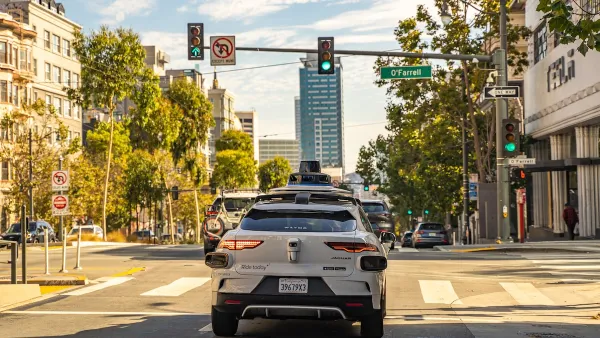
NHTSA Cuts Could Make Roads More Dangerous
The agency is losing almost half of the team that oversees autonomous vehicle safety, among dozens of other key personnel.
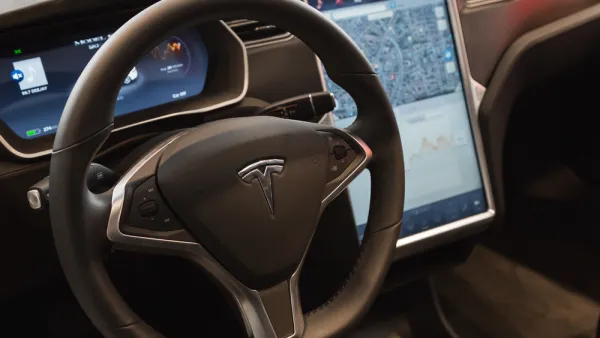
Tesla's 'Aggressive' Autonomous Mode Facilitates Lawbreaking
Some Tesla autonomous modes direct the vehicle to engage in dangerous and illegal behaviors, prompting calls for increased regulation of autonomous vehicle tech.
Watch: The Car-Centric Legal System, Explained
So many subsidies ensure the dominance of the automobile in the daily live of the United States, it's hard to keep track of them all. Law Professor Greg Shill is keeping track, however.

Planetizen Federal Action Tracker
A weekly monitor of how Trump’s orders and actions are impacting planners and planning in America.

California plans to bury El Niño’s downpour
If the state plays its cards right, it may be able to store a billion acre-feet of El Niño’s water in aquifers.

Desperate measures: Advocates weigh draining Lake Powell to fill Colorado River
Draining the reservoir could reduce evaporation losses by a couple hundred thousand acre-feet.

Mamdani’s pied-à-terre tax survives legal challenge
A panel of judges found that the plaintiffs failed to demonstrate injury as a result of New York City's implementation of the tax.

Eastern Nebraska is running out of electricity
Data centers and electrification are straining eastern Nebraska’s grid, throttling economic development.

Seattle passes record-breaking transit services expansion
Proposition 1 will double the city’s transit tax to add 95,000 more bus trips and preserve 180,000 bus trips annually.

FREE Course: Walkable City 1: Why Walkability?
After describing his path towards focusing on walkability as the essence of good planning, Jeff Speck marches through his five principal reasons for making more walkable places.
Reinventing Malls: Planning Alchemy—Turning Gray Fields Into Gold
The course focuses on the opportunities and imperatives that shape reinvention of mall sites.

City of Rosemead
Rutgers University, Edward J. Bloustein School of Planning and Public Policy
One Hundred Miles
University of Michigan School for Environment and Sustainability (SEAS)
Hunter College, City University of New York (CUNY)
The Architects Foundation
City of Cambridge
Montrose County
The Pocatello Development Authority