Results showing progress in the fight to end traffic fatalities have disappeared, just like some of the safety projects installed under the banner of Vision Zero.


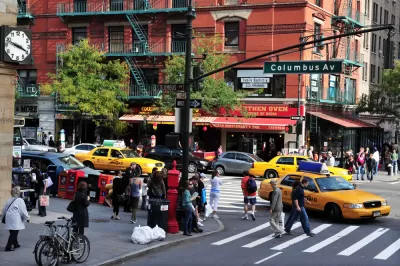
Nicole Gelinas reflects on a deadly week on the streets of New York City—"six people killed in car crashes in just two days"—following a "bloody summer for walkers and bicyclists."
According to Gelinas, the death toll raises the question of how seriously Mayor Bill de Blasio is taking his Vision Zero campaign to end road deaths by 2024. According to Gelinas, the city reduced traffic deaths an encouraging amount in 2014 and 2015, but 2016 isn't looking likely to continue that trend.
Gellinas suggests that the city isn't doing enough, fast enough, to invest in pedestrian and bike safety. The city has also worked to opposite effect recently, as exemplified by city's recent decision to remove "pedestrian islands along Brooklyn’s dangerous Eastern Parkway," designed "to help schoolchildren cross the street more safely."
An article by David Meyer puts that decision in perspective:
DOT removed pedestrian islands on Eastern Parkway in Crown Heights yesterday, undoing years of street safety advocacy work on the part of local residents and community board members with no public process, and no one in the de Blasio administration is taking responsibility.
Meyer's article also shows evidence of the buck being passed around by the Mayor's Office, the NYPD, and the DOT. A follow-up article the next day, also by Meyer, reports that Mayor de Blasio eventually blamed the decision on an unnamed local politician.
Read the full story: Why de Blasio hit a wall on stopping traffic deaths
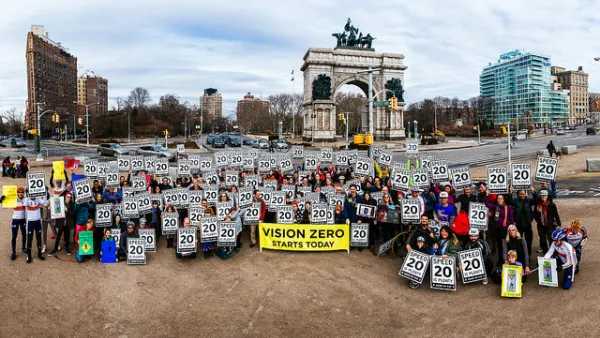
Zero Vision Zero: Streets Deadlier Now Than When De Blasio Started
Mayor Bill de Blasio in 2014 set a goal to eliminate traffic fatalities from New York City. Now, with de Blasio preparing to leave office, more people are dying on the city's streets than when he made that announcement.
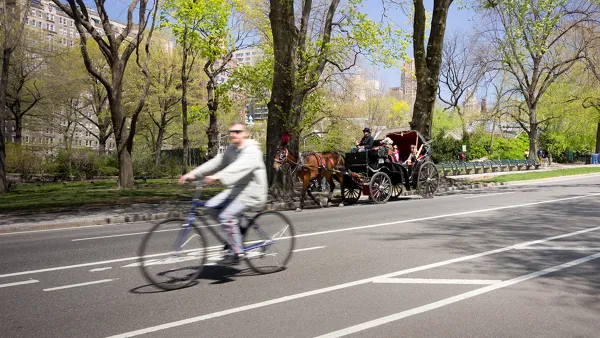
After Compromise, 'Streets Master Plan' Headed for Approval in New York City
The New York City Council is expected to pass a "Streets Master Plan" this week that City Council Speaker Corey Johnson describes as designed to "break the car culture."
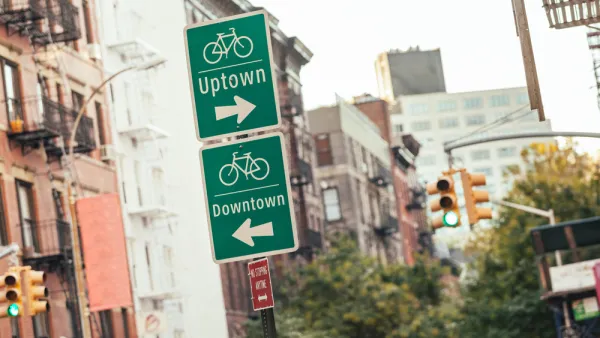
After 17 Deaths in 2019, New York Has a New Bike Safety Plan
Vision Zero has tragically failed 17 people on bikes in New York City this year, and Mayor Bill de Blasio couldn't stick with the status quo any longer.

Desperate measures: Advocates weigh draining Lake Powell to fill Colorado River
Draining the reservoir could reduce evaporation losses by a couple hundred thousand acre-feet.

Eastern Nebraska is running out of electricity
Data centers and electrification are straining eastern Nebraska’s grid, throttling economic development.

Malls are becoming the midtowns of the future
Mall and office park redevelopments are a generational opportunity to create new nodes of urbanity.

NYC breaks ground on anti-flooding infrastructure project
New York City's new system will reduce stormwater flows to local sewers by 90%.

One Kentucky town’s secret to affordable housing
The Smoketown Community Land Trust has already built seven affordable homes for community members.

Houston gains petal-shaped cooling infrastructure to make streets more ‘delightful’
The city has installed the pavilions along 15 blocks in Houston.

FREE Course: Walkable City 1: Why Walkability?
After describing his path towards focusing on walkability as the essence of good planning, Jeff Speck marches through his five principal reasons for making more walkable places.
Reinventing Malls: Planning Alchemy—Turning Gray Fields Into Gold
The course focuses on the opportunities and imperatives that shape reinvention of mall sites.

City of Rosemead
Rutgers University, Edward J. Bloustein School of Planning and Public Policy
One Hundred Miles
University of Michigan School for Environment and Sustainability (SEAS)
Hunter College, City University of New York (CUNY)
The Architects Foundation
City of Cambridge
Montrose County
The Pocatello Development Authority