Similar to a local proposal by San Francisco cyclists to reduce priority for for ticketing cyclists for rolling through stop signs, a state senator hopes to do with state legislation for motorists making "California Stops" at red lights.


There are probably more differences than similarities between the Idaho and California stop proposed legislation: one is local, applying to San Francisco only, the other is state legislation. One would waive the ticket, the other merely reduces the fine. And of course, one applies to bikes, the other to motor vehicles.
But what they share in common is that in each case, the legislation applies to vehicles which do not make a "complete stop," currently illegal for both bikes at stop signs and motorists making a permitted "right on red."
San Francisco Mayor Ed Lee has vowed to veto the San Francisco "Idaho Stop" proposal, which has majority, but not veto-proof, support among the Board of Supervisors.
Senate Bill 681, authored by Senator Jerry Hill (D-San Mateo) cruised through the Senate Transportation and Housing Committee on Jan. 12, receiving unanimous support "before being referred to the Appropriations Committee," writes Samantha Weigel of the Daily Journal.
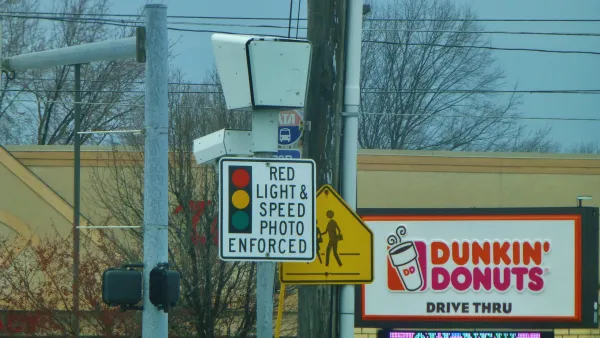
Hill’s Senate Bill 681 proposes reducing the current base amount of the violation to $35 instead of the current $100, an amount typically reserved for dangerous maneuvers like speeding in excess of 25 mph. Straight through red light and left turn on red violations would remain subject to the $100 base fine, according to Hill’s office.
Hill emphasized he’s not advocating that the law shouldn’t be enforced, but that the penalty shouldn’t be excessive or overly burdensome — particularly as statistics show few accidents are caused by the infraction.
Weigel provides data, though somewhat dated, to back up that last point:
Of the 6.3 million crashes nationwide in 1998, less than .04 percent involved a driver making a right turn on a red light, according to a 2001 National Highway Traffic Safety Administration (NHTSA) study. Yet the majority of red light cameras tickets in many cities, particularly San Mateo and Los Angeles, are issued to drivers making slow-moving right turns, according to Hill.
A review of past Planetizen posts on red light cameras shows the vast majority aimed at either eliminating or supporting the use of red light cameras. Considering that use of these controversial cameras "has been in decline since 2013," wrote Daniel C. Vock for Governing last March, a reduced fine for illegal right-hand turns may not be such a bad thing if it prevents more cities from eliminating them all together.
Read the full story: Sen. Jerry Hill takes on red light cameras: Proposed legislation would reduce fine for rolling through right turns

Caltrain Electrification Broke Ground on Friday
Gov. Jerry Brown, Peninsula congresswomen, including House Minority Leader Nancy Pelosi, and state legislative leaders gathered in Millbrae with shovels-in hands to mark the beginning of a four-year construction project to electrify Caltrain.
Disabling Red Light Cameras Increases Traffic Fatalities
A new study shows what happens when cities remove red light cameras, which have become targeted by many motorists and eliminated by at least 158 cities. Fatal crashes increased 30 percent compared with area cities that kept the controversial cameras.

As San Francisco Debates Idaho Stop, Gov. Brown Gives All Cyclists a Break
Regardless of how San Francisco's proposed Bike Yield Law fares, all California cyclists who are ticketed for not stopping at stop signs may have the option to pay a reduced fine if they opt to attend bike school thanks to a new law signed Sept. 21.

Planetizen Federal Action Tracker
A weekly monitor of how Trump’s orders and actions are impacting planners and planning in America.

Amtrak, CN end decades-long dispute with eight-year agreement
The new operating agreement establishes an updated framework for the companies to work together, including processes to resolve disputes.

Judges permit Denver to divert 77,000 acre feet from the Colorado River for reservoir expansion
Overuse and climate change have caused the Colorado River’s water levels to plummet.

Trump to overrule local leaders, lease millions of acres of America’s Pacific Island territories’ seafloors to mining companies
International law says that the Indigenous people of America’s territories have a right to prior and informed consent regarding projects that impact their countries.

A ‘shady’ deal: Chicagoans rally against planned Amtrak maintenance facility
The $900 million facility would allow Amtrak to maintain entire trains in one building, which the company says will reduce delays.

NYC releases high-tech public restrooms — with a 10 minute time limit
The $4 million pilot program aims to make it easier for people to find public restrooms in New York City.

FREE Course: Walkable City 1: Why Walkability?
After describing his path towards focusing on walkability as the essence of good planning, Jeff Speck marches through his five principal reasons for making more walkable places.
Reinventing Malls: Planning Alchemy—Turning Gray Fields Into Gold
The course focuses on the opportunities and imperatives that shape reinvention of mall sites.

KFH Group Inc.
Greater Baltimore Committee
Eagle County Government
The Architects Foundation
University of Cincinnati Online
The Pocatello Development Authority
The Urban Renewal Agency of the City of Pocatello