London is the stage for one of the problems that arises when encountered with a dearth of accommodations for housing and offices.


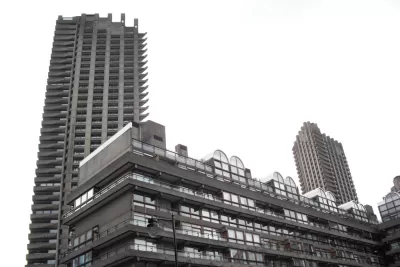
Elli Thomas explains the embarrassment of riches pressuring London: growing demand for housing is creating competition for the commercial and offices spaces that drive the city's economy.
While adding additional supply is critical to the affordability of the city, Thomas acknowledges, existing office space is critical for long-term economic growth. Calling on research by the Centre for Cities, Thomas picks a side in this contest, arguing that "as a result of specific national policies, the ability of cities to maintain an appropriate balance between residential and commercial space is under threat."
The policies in question relate to country's Permitted Development Rights (PDRs), which allows changes of use without full planning permission. "In May 2013," explains Thomas, "[PDRs were] extended to include the conversion of underused office space to residential..." Despite reassurances that the policy change wouldn't lead to a spike in planning applications, London's PDR applications shot up in 2014, and local authorities are having trouble resisting the loss of commercial space to new housing.
The problem, according to Thomas, is that the PDR policy will be beneficial to many parts of Britain, but now a fast-growing, high-demand city like London.
Read the full story: Cities need the flexibility to decide between housing and office space

New Jersey affordable housing requirements spur infill development across the state
A 50-year-old law continues to reshape development around housing goals.

Office conversion is picking up steam in San Francisco
The city spent five years streamlining approval processes and reducing fees to encourage more adaptive reuse of vacant office buildings.

Vacant downtown LA office building will be transformed into 512 affordable homes
The World Trade Center will create hundreds of new apartments with rents starting as low as $937.

Planetizen Federal Action Tracker
A weekly monitor of how Trump’s orders and actions are impacting planners and planning in America.

California plans to bury El Niño’s downpour
If the state plays its cards right, it may be able to store a billion acre-feet of El Niño’s water in aquifers.

Desperate measures: Advocates weigh draining Lake Powell to fill Colorado River
Draining the reservoir could reduce evaporation losses by a couple hundred thousand acre-feet.

Mamdani’s pied-à-terre tax survives legal challenge
A panel of judges found that the plaintiffs failed to demonstrate injury as a result of New York City's implementation of the tax.

Eastern Nebraska is running out of electricity
Data centers and electrification are straining eastern Nebraska’s grid, throttling economic development.

Seattle passes record-breaking transit services expansion
Proposition 1 will double the city’s transit tax to add 95,000 more bus trips and preserve 180,000 bus trips annually.

FREE Course: Walkable City 1: Why Walkability?
After describing his path towards focusing on walkability as the essence of good planning, Jeff Speck marches through his five principal reasons for making more walkable places.
Reinventing Malls: Planning Alchemy—Turning Gray Fields Into Gold
The course focuses on the opportunities and imperatives that shape reinvention of mall sites.

City of Rosemead
Rutgers University, Edward J. Bloustein School of Planning and Public Policy
One Hundred Miles
University of Michigan School for Environment and Sustainability (SEAS)
Hunter College, City University of New York (CUNY)
The Architects Foundation
City of Cambridge
Montrose County
The Pocatello Development Authority