Senate Bill 840, which was preliminarily approved by the state House, would allow residential construction in areas previously zoned for offices and commercial uses.


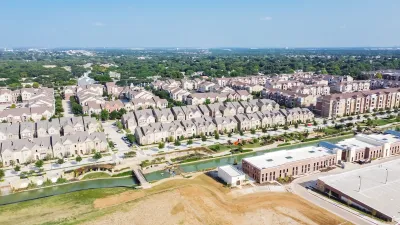
A proposed Texas state bill, Senate Bill 840, would allow housing construction along retail and commercial corridors. The bill would let property owners build residential units on land previously zoned for commercial or office uses without rezoning.
“There’s broad support among Texas voters for allowing more homes in business and shopping districts and vacant office and commercial buildings to become homes, a recent poll conducted by YouGov and Texans for Housing found.”
According to reporting by Joshua Fechter in The Texas Tribune, “The bill would only apply to Texas’ largest cities. It’s limited to cities that have a population greater than 150,000 people that sit in a county with at least 300,000 residents.”
Housing experts estimate Texas’s need for new housing at roughly 320,000 units. Lawmakers have also introduced bills that would allow smaller lots and ADUs and streamline permitting.
Read the full story: Vacant offices, strip malls may get new life as housing in Texas’ largest cities


Midtown Manhattan Rezoning Proposal Could Yield Almost 10,000 Housing Units
A plan to alter zoning for parts of Midtown would permit new housing and make it easier to convert office buildings to residential units.

Office Conversion Sees No Sign of Slowing
The adaptive reuse of office buildings for residential and other uses will grow by as much as 63 percent in 2024 over last year.

Office conversion is picking up steam in San Francisco
The city spent five years streamlining approval processes and reducing fees to encourage more adaptive reuse of vacant office buildings.

Planetizen Federal Action Tracker
A weekly monitor of how Trump’s orders and actions are impacting planners and planning in America.

California plans to bury El Niño’s downpour
If the state plays its cards right, it may be able to store a billion acre-feet of El Niño’s water in aquifers.

Chicago breaks ground on $3 billion megadevelopment
The new neighborhood, titled Foundry Park, will one day host 3,700 residences.

California High-Speed Rail Authority CEO resigns after $600,000 scandal
Under Ian Choudri, the authority used taxpayer dollars to fund first class flights and trips to nightclubs.

Want to study the Missouri River? Soon, you may need unanimous approval from 10 states
Legislation would require 10 governors’ permission to study or build projects moving water outside the basin.

Desperate measures: Advocates weigh draining Lake Powell to fill Colorado River
Draining the reservoir could reduce evaporation losses by a couple hundred thousand acre-feet.

FREE Course: Walkable City 1: Why Walkability?
After describing his path towards focusing on walkability as the essence of good planning, Jeff Speck marches through his five principal reasons for making more walkable places.
Reinventing Malls: Planning Alchemy—Turning Gray Fields Into Gold
The course focuses on the opportunities and imperatives that shape reinvention of mall sites.

City of Rosemead
Rutgers University, Edward J. Bloustein School of Planning and Public Policy
One Hundred Miles
Hunter College, City University of New York (CUNY)
The Architects Foundation
University of Cincinnati Online
City of Cambridge
Montrose County
The Pocatello Development Authority