A week before a Nov. 3 Maine transportation referendum on a *general fund bond issue to address roads and bridges, TRIP released a report showing that over a third of the state's bridges "are structurally deficient or functionally obsolete."


[Updated 11/2/15] "On Nov. 3, Mainers will vote on three statewide referendum questions," writes state Representative Andrew J. McLean (D-Gorham), chairman of the Transportation Committee, in an opinion for Kennebec Journal on Central Maine.com to support Question 3.
From Maine.gov: November 3, 2015 - Referendum Election:
Question 3: Bond Issue
Do you favor an $85,000,000 bond issue for construction, reconstruction and rehabilitation of highways and bridges and for facilities and equipment related to ports, harbors, marine transportation, freight and passenger railroads, aviation, transit and bicycle and pedestrian trails, to be used to match an estimated $121,500,000 in federal and other funds?
Eighty percent, or "$68 million of these funds will be used to construct and repair state highways, repair secondary roads in partnership with local communities and replace or rehabilitate bridges," writes McLean. "The remaining $17 million would be dedicated to a variety of other projects with the priority of identifying and targeting those that most improve public safety and support economic growth."
"The TRIP report, 'Preserving Maine’s Bridges: The Condition and Funding Needs of Maine’s Bridge System' (pdf), finds that 15 percent of Maine’s state and locally maintained bridges are structurally deficient, which means there is significant deterioration of the bridge supports or other major components," states the Washington, DC based national transportation organization's press release. The acronym previously stood for The Road Information Project.
"Lawmakers voted overwhelmingly in favor of issuing the $85 million in bonds for these transportation needs before sending the proposal to Maine voters for final approval, as required by the Maine Constitution," notes Rep. McLean.
There should be little question as to whether the funds are necessary. McLean compares Maine to New Hampshire, a state with comparable population (1.327 million) but half the number of roads and bridges.
However, after consider effort, New Hampshire increased its gas tax by 4.2-cents per gallon to 24 cents last year. Maine's 30-cent gas tax hasn't changed since 1993, according to an informative article from MPBN, Maine's NPR News Source.
Voters backed a $100 million bond measure two years ago.
Regrettably, McLean doesn't mention that bond measures are not a sustainable strategy to address transportation funding. User fees, such as gas taxes or tolls, are not mentioned. Interestingly, he took the same approach last year in an opinion piece posted here.
Hat tip to AASHTO Journal.
*The post was updated to reflect the referendum's approval of a general fund bond issue, rather than a property tax.
FULL STORY: Funding for safer roads, stronger economy goes to voters Nov. 3

Pop Quiz: What State Has Highest Percentage of Deficient Bridges?
Hint: It's also the smallest by area. And the next two on the "first is worst" list are in the Northeast as well. According to 2014 FHWA data, over 50 percent of this state's bridges are considered deficient, either structurally or functionally.
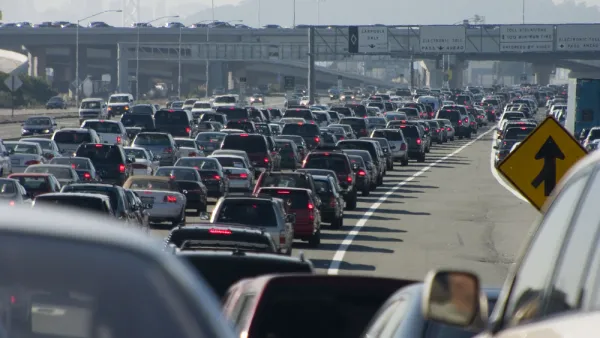
Bad Roads and Bridges Costing California Motorists as Much as $2,800 Annually
The transportation research group, TRIP, tallied costs from additional crashes, higher operating costs, and congestion that result from insufficient investment in California's roads and bridges. A new effort was launched to increase state funding.
Mainers to Vote on Transportation Bond on Nov. 5
At $100 million, it is the largest of the five bonds on the Nov. 5 ballot. While six other transportation bonds were voted on (and approved) since 2000, the need for this bond comes from a 2011 law that eliminated the indexing of the state gas tax.

Planetizen Federal Action Tracker
A weekly monitor of how Trump’s orders and actions are impacting planners and planning in America.

The state-sanctioned urbicide of Austin
People don’t kill cities. Freeways do.

US to reduce Colorado River water deliveries to Mexico
A new Colorado Treaty amendment reduces Mexico’s Colorado River water allocation by 250,000 acre feet.

5 New England states march closer to 800 megawatt wind energy project
Securing federal approval for the project may be complicated under the Trump administration, which has historically been hostile towards domestic wind power.

Baltimore to break ground on $50 million Transit Priority Project
The project will bring faster bus trips, safer streets and better bike connections to Baltimore.

Airbnb launches $250 million 'last-dollar financing' housing accelerator, makes first investment in Austin
The company will put $6.4 million towards affordable housing development in Texas’ capital.

FREE Course: Walkable City 1: Why Walkability?
After describing his path towards focusing on walkability as the essence of good planning, Jeff Speck marches through his five principal reasons for making more walkable places.
Reinventing Malls: Planning Alchemy—Turning Gray Fields Into Gold
The course focuses on the opportunities and imperatives that shape reinvention of mall sites.

Eagle County Government
Harvard University Graduate School of Design
Nashville Planning Department
The Architects Foundation
University of Cincinnati Online
The Pocatello Development Authority
The Urban Renewal Agency of the City of Pocatello
Journal of the American Planning Association