Seattle will implement a process by which neighborhoods can take the Tactical Urbanism practice of DIY sidewalks a step further—by officially approving local designs for sidewalks.


Tom Fucoloro reports that the Seattle Department of Transportation "announced a new program to allow neighborhoods to officially implement custom crosswalks."
Fucoloro notes that the process will take longer and cost more than a guerrilla effort, but the official crosswalks will last longer and also meet safety standards. Also, "it is a cool side-effect of the action that now communities have this new option for creating public art or identity markings right in the middle of their streets."
"It will take some fundraising or winning a Neighborhood Matching Fund grant, but that’s a small price to pay for a community-building addition like this. Because the streets belong to everyone, and this is just one more way to say so," concludes Fucoloro.
Hat tip to Angie Schmitt for sharing the news on Streetsblog USA.
Read the full story: Seattle will let neighborhoods design their own crosswalks
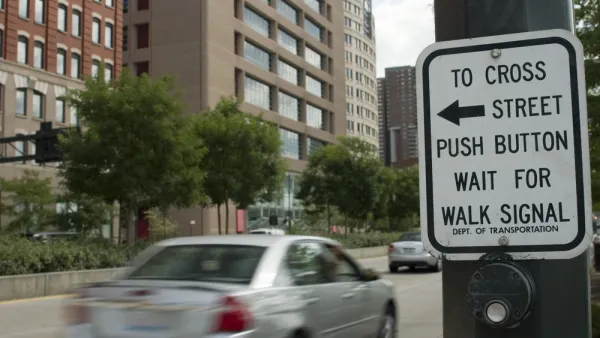
Seattle Recalculates Walk Signal Timing to Make Crossings Safer for Pedestrians
The new formulas for calculating the length of walk signals are designed to give people more time to safely cross the street.
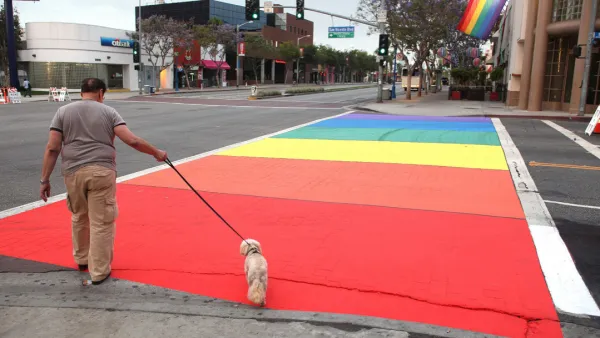
Re-Examining the Safety of Colorful Crosswalks
There has been no shortage of responses to the story about St. Louis letting decorated sidewalks fade away after encountering federal policy that recommends more subdued colors.
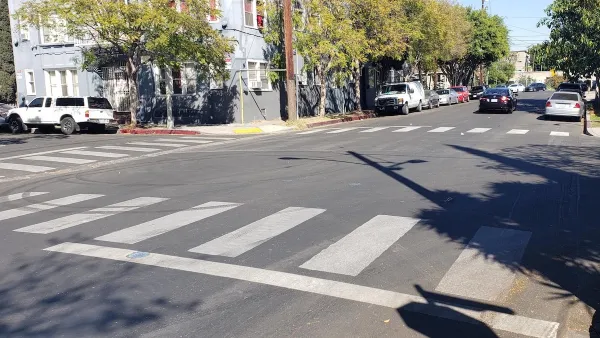
Guerilla Urbanism Spurs Action From Cities
Rather than take a hostile approach to DIY urbanism, some cities are using guerilla efforts as an opportunity to understand critical infrastructure gaps.

Planetizen Federal Action Tracker
A weekly monitor of how Trump’s orders and actions are impacting planners and planning in America.

California plans to bury El Niño’s downpour
If the state plays its cards right, it may be able to store a billion acre-feet of El Niño’s water in aquifers.

Desperate measures: Advocates weigh draining Lake Powell to fill Colorado River
Draining the reservoir could reduce evaporation losses by a couple hundred thousand acre-feet.

US buildings threatened, destroyed by fires set to triple by 2060
Researchers found a high fire risk for socioeconomically vulnerable neighborhoods in the American West.

LA residents may be allowed to paint their own crosswalks
Councilwoman Katy Yaroslavsky put out a motion instructing the Los Angeles Department of Public Transportation to study the feasibility of allowing volunteers to paint crosswalks.

Dallas moves to overhaul its zoning code
The city's zoning reform will allow more multi-family and mixed-use developments.

FREE Course: Walkable City 1: Why Walkability?
After describing his path towards focusing on walkability as the essence of good planning, Jeff Speck marches through his five principal reasons for making more walkable places.
Reinventing Malls: Planning Alchemy—Turning Gray Fields Into Gold
The course focuses on the opportunities and imperatives that shape reinvention of mall sites.

City of Rosemead
Rutgers University, Edward J. Bloustein School of Planning and Public Policy
One Hundred Miles
Hunter College, City University of New York (CUNY)
The Architects Foundation
University of Cincinnati Online
City of Cambridge
Montrose County
The Pocatello Development Authority