There has been no shortage of responses to the story about St. Louis letting decorated sidewalks fade away after encountering federal policy that recommends more subdued colors.


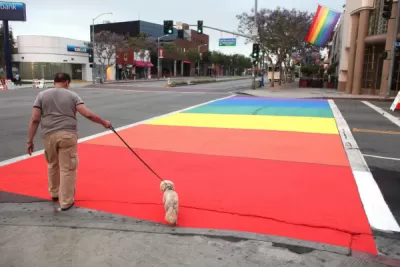
Following news reported last weekend by the St. Louis Post-Dispatch that the city would let examples of decorated crosswalks fade away after determining they ran afoul of Federal Highway Administration policies, advocates and planners from around the country have spoken out.
First, Angie Schmitt responded with a pointed response to St. Louis, arguing that perhaps St. Louis Bike and Pedestrian Coordinator Jamie Wilson was being too stringent with his interpretation of the federal policy. Schmitt calls on an expert to show another way of responding to the policy:
Conor Semler, a planning consultant with the Boston-based firm Kittelson & Associates, said most cities he works with have interpreted the FHWA memo much differently. Cities like Baltimore — famous for its eye-catching zipper crosswalk — and Seattle have basically determined 'as long as the white transverse lines are clear, you can do almost anything inside that,' he said.
Speaking of Seattle, the Capitol Hill Times mobilized its staff in the wake of the story to follow up with Seattle Department of Transportation City Traffic Engineer Dongho Chang about the safety outcomes of the 11 rainbow crosswalks added to the neighborhood of Capitol Hill in the summer of 2015. According to the article, the crosswalks, "have not caused concerns from the city’s transportation department, clearing six months of review without a single pedestrian-involved collision."
Read the full story: Get Real — Colorful Crosswalks Aren’t Endangering Pedestrians

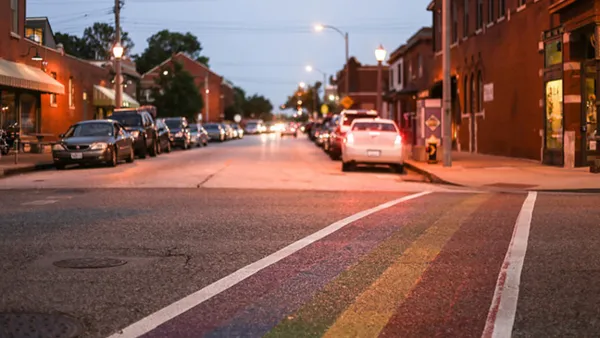
Painted Crosswalks Don't Pass Feds' Eyeball Test in St. Louis
St. Louis will end a program that allows groups to decorate crosswalks for the purposes of beautifying and branding neighborhoods. Currently decorated crosswalks can stay, for now.
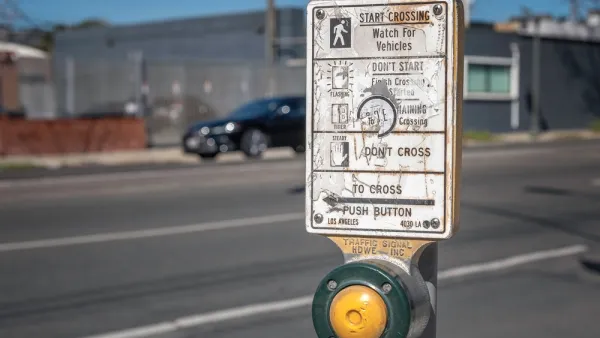
Tactical Urbanism Makes Strides in L.A.
A DIY urbanism group in Los Angeles has successfully prompted the city to install permanent crosswalks at dangerous intersections, despite the city’s insistence that the group’s do-it-yourself work is illegal.

How Tactical Urbanism Succeeds Where Bureaucracy Fails
Making the case for do-it-yourself infrastructure.

Planetizen Federal Action Tracker
A weekly monitor of how Trump’s orders and actions are impacting planners and planning in America.

Amtrak, CN end decades-long dispute with eight-year agreement
The new operating agreement establishes an updated framework for the companies to work together, including processes to resolve disputes.

Judges permit Denver to divert 77,000 acre feet from the Colorado River for reservoir expansion
Overuse and climate change have caused the Colorado River’s water levels to plummet.

San Diego may kill one-third of its bus routes as budget crisis looms
Under the city's proposed plan, 21% of Metropolitan Transit System riders would lose access to transit services.

Philadelphia to invest $2 billion into upgrading city airports as PHL places last in customer satisfaction
Modernizations to Philadelphia's airports will include baggage system upgrades and a new automated parking garage guidance system.

The LA housing policies making developers turn away from the city
Despite LA’s housing shortage, developers say the city’s "mansion-tax" and pandemic-era policies make it an unappealing place to build housing.

FREE Course: Walkable City 1: Why Walkability?
After describing his path towards focusing on walkability as the essence of good planning, Jeff Speck marches through his five principal reasons for making more walkable places.
Reinventing Malls: Planning Alchemy—Turning Gray Fields Into Gold
The course focuses on the opportunities and imperatives that shape reinvention of mall sites.

City of Wisconsin Rapids
Harvard University Graduate School of Design
KFH Group Inc.
The Architects Foundation
University of Cincinnati Online
The Pocatello Development Authority
The Urban Renewal Agency of the City of Pocatello