The bike lane on a well-traveled street through Philadelphia has faded beyond recognition. Appeals to restripe the lane have focused on a forthcoming visit from the pope.


"On parts of Pennsylvania Avenue between Spring Garden Avenue and 27th Street, the bike lane paint is so faint on both sides of the street that it can barely be seen," according to an article by Holly Otterbein. "It leads cyclists and drivers alike to believe that the bike lanes simply don’t exist."
The state of the bike lane in Philadelphia even prompted criticism from the U.S. Department of Transportation on Twitter.
The article goes into more detail about the important of regular, consistent, and well-marked lanes. Philadelphia, of course, is expecting a visit from Pope Francis in September. Otterbein has made more than one appeal for repairs to be made in the public realm prior to the pope's visit—which shouldn't detract from the importance of everyday users of public facilities. And Philadelphia is, at least, lucky in having that motivation—as other cities around the country have also dealt with bike infrastructure not standing up to the wear and tear of city life.
Read the full story: Fix It: The Incredible Vanishing Bike Lanes on Pennsylvania Avenue Read more at http://www.phillymag.com/citified/2015/08/06/fix
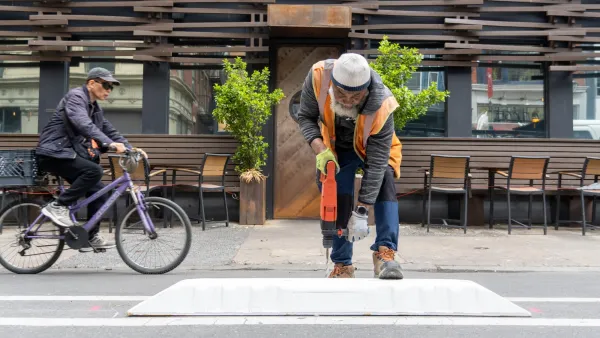
Philadelphia adds new safety measures to 13th Street bike lane
The city is piloting plastic, modular bike lane separators that buffer cyclists from the adjacent vehicle lane.
Philadelphia Swaps Car Lanes for Bikeways in Unanimous Vote
The project will transform one of the handful of streets responsible for 80% of the city’s major crashes.
Philly Council Wants to Crack Down on Bike Lane Parking
The city council passed a bill that would raise penalties and eliminate a grace period for drivers who stop in bike lanes.

Planetizen Federal Action Tracker
A weekly monitor of how Trump’s orders and actions are impacting planners and planning in America.

Washington state to charge fee to drivers with fuel-efficient cars
Revenue from the fee will go towards supporting the state’s highways.

Illinois considers spending $1 billion in taxpayer money on data center
A quantum computing campus and data center are currently under construction in Chicago.

Did data centers change how voters cast their ballots?
Texas, Ohio, and Georgia all flipped party control. But in rural counties, the effect of local data centers was mixed.

Amtrak invests in eight new Airo trainsets
The new trainsets will begin serving passengers in 2031.

HUD to end aid for mixed-immigration-status households
The new rule is projected to impact 80,000 people, nearly half of whom are children.

FREE Course: Walkable City 1: Why Walkability?
After describing his path towards focusing on walkability as the essence of good planning, Jeff Speck marches through his five principal reasons for making more walkable places.
Reinventing Malls: Planning Alchemy—Turning Gray Fields Into Gold
The course focuses on the opportunities and imperatives that shape reinvention of mall sites.

City of Charlotte
City of Rosemead
Rutgers University, Edward J. Bloustein School of Planning and Public Policy
University of Michigan School for Environment and Sustainability (SEAS)
Hunter College, City University of New York (CUNY)
The Architects Foundation
University District Partnership