The city council passed a bill that would raise penalties and eliminate a grace period for drivers who stop in bike lanes.


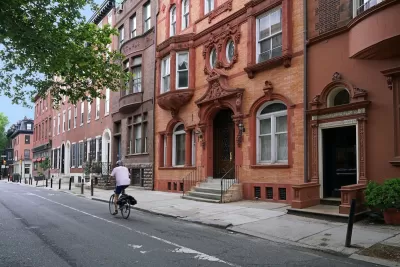
A new Philadelphia bill passed by the City Council would raise penalties for drivers who park or stop in bike lanes. If signed by the mayor, the law would increase fines to $125 in Center City and University City and $75 in other neighborhoods and remove a 25-minute grace period, reports Michaela Althouse for Philly Voice.
The law is part of the city’s effort to increase safety for cyclists. “Those who support the stricter laws say when a vehicle is stopped in a bike lane, it forces cyclists to swerve into traffic, endangering them. They also argued that being able to temporarily park directly in front of a home is a luxury that doesn't exist for many residents. ”
According to Althouse, “The bill notably does not include installing concrete barriers, another proposed bike safety solution that's been hotly contested. But the city's Office of Transportation and Infrastructure Systems has said it plans to add them at Spruce and Pine streets, subject to community approval.”
FULL STORY: Artificial Intelligence in Cities Trend Report 2024

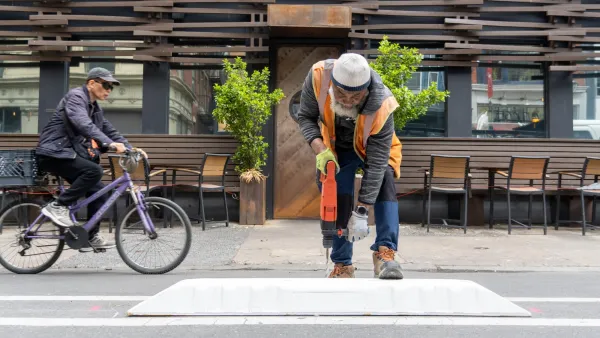
Philadelphia adds new safety measures to 13th Street bike lane
The city is piloting plastic, modular bike lane separators that buffer cyclists from the adjacent vehicle lane.

The 5 Safest Cities for Cyclists in America — and What They Have in Common
Cities with low fatality rates for people on bikes have made strong commitments to building safe, protected bike networks and supporting Complete Streets.
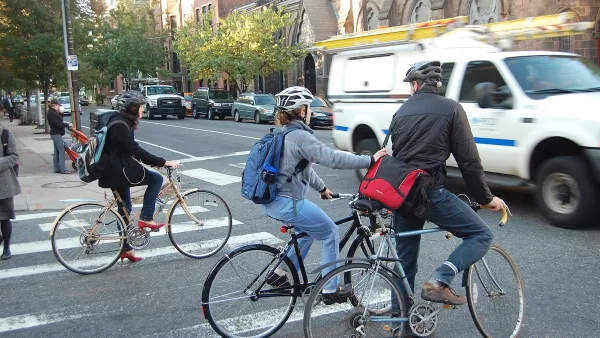
Philadelphia Swaps Car Lanes for Bikeways in Unanimous Vote
The project will transform one of the handful of streets responsible for 80% of the city’s major crashes.

Planetizen Federal Action Tracker
A weekly monitor of how Trump’s orders and actions are impacting planners and planning in America.

The state-sanctioned urbicide of Austin
People don’t kill cities. Freeways do.

US to reduce Colorado River water deliveries to Mexico
A new Colorado Treaty amendment reduces Mexico’s Colorado River water allocation by 250,000 acre feet.

5 New England states march closer to 800 megawatt wind energy project
Securing federal approval for the project may be complicated under the Trump administration, which has historically been hostile towards domestic wind power.

Baltimore to break ground on $50 million Transit Priority Project
The project will bring faster bus trips, safer streets and better bike connections to Baltimore.

Airbnb launches $250 million 'last-dollar financing' housing accelerator, makes first investment in Austin
The company will put $6.4 million towards affordable housing development in Texas’ capital.

FREE Course: Walkable City 1: Why Walkability?
After describing his path towards focusing on walkability as the essence of good planning, Jeff Speck marches through his five principal reasons for making more walkable places.
Reinventing Malls: Planning Alchemy—Turning Gray Fields Into Gold
The course focuses on the opportunities and imperatives that shape reinvention of mall sites.

Eagle County Government
Harvard University Graduate School of Design
Nashville Planning Department
The Architects Foundation
University of Cincinnati Online
The Pocatello Development Authority
The Urban Renewal Agency of the City of Pocatello
Journal of the American Planning Association