In Los Angeles, Proposition D has done its job over the past two years, putting a damper on new medical marijuana shops and dispensaries. Meanwhile, California inches toward decriminalization.


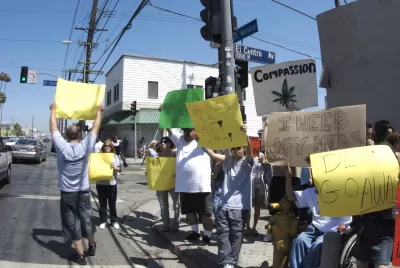
Most estimate it's only a matter of time before California opts for full decriminalization of weed. Until then, Los Angeles Proposition D still stands, limiting the number of medical marijuana dispensaries to the number present in 2007: approximately 140. In accordance with the law, over 500 shops have closed throughout the city.
A set of stringent rules governs dispensaries: "The requirements include things like being registered under past city ordinances and maintaining a certain distance between your dispensary and public parks and schools."
City medical marijuana policy remains a fraught issue, with some arguing that enforcement of a half-measure isn't worth the trouble. Until California moves to legalize (or fully prohibit) weed sales, "city officials have no official way to know how many dispensaries are still operating, making the crackdown [...] a murky game of whack-a-mole."
Read the full story: Over 500 L.A. Pot Shops Have Closed in the Last Two Years

Another State Rejects a 10-Cents per Gallon Gas Tax Hike
It was not your basic fuel tax hike. Utah voters were told that raising the tax would help education by redirecting revenue from the General Fund to schools that currently goes to transportation. Yet voters also passed decidedly liberal initiatives.

DUIDs Surpass DUIs as Cause of Fatal Vehicle Crashes
2015 was the first year that driving under the influence of drugs (DUID) surpassed those killed while driving under the influence of alcohol. Increased legal access to marijuana is correlated with the surge. Amphetamine use is also a factor.
Marijuana Manufacturing Sets Up Shop in Denver's Communities of Color
Advocates are concerned that too many of Denver's new retail marijuana business are locating in neighborhoods with mostly minority and low-income residents.

Planetizen Federal Action Tracker
A weekly monitor of how Trump’s orders and actions are impacting planners and planning in America.

Eastern Nebraska is running out of electricity
Data centers and electrification are straining eastern Nebraska’s grid, throttling economic development.

Study reveals best places in the U.S. for cycling, walking
New research from Streetlight Data examines bicycle and pedestrian miles per capita in the 100 largest U.S. cities by population.

Why does it take an emergency for the U.S. to expedite infrastructure projects?
In June 2023, Philadelphia repaired a melted interstate in 12 days thanks to an emergency order.

Federal government nominates new FTA administrator
Mark Aesch is currently the founder and CEO of a transportation management consulting firm.

Developers reveal $10 billion stadium plan as ‘Hail Mary’ to keep Bears in Chicago
The plan would also boast a public park, high- and mid-rise buildings and a youth sports complex.

FREE Course: Walkable City 1: Why Walkability?
After describing his path towards focusing on walkability as the essence of good planning, Jeff Speck marches through his five principal reasons for making more walkable places.
Reinventing Malls: Planning Alchemy—Turning Gray Fields Into Gold
The course focuses on the opportunities and imperatives that shape reinvention of mall sites.

City of Charlotte
City of Rosemead
Rutgers University, Edward J. Bloustein School of Planning and Public Policy
University of Michigan School for Environment and Sustainability (SEAS)
Hunter College, City University of New York (CUNY)
The Architects Foundation
City of Cambridge
The Pocatello Development Authority
The Urban Renewal Agency of the City of Pocatello