Advocates are concerned that too many of Denver's new retail marijuana business are locating in neighborhoods with mostly minority and low-income residents.


"Recreational marijuana businesses have proliferated so rapidly in some of Denver's poorer neighborhoods during the past two years that city officials are exploring ways to disperse future growth more evenly," report David Migoya and Ricardo Baca.
Businesses connected to the marijuana industry have taken off in neighborhoods like Elyria Swansea, Globeville, Northeast Park Hill, and Overland, according to the article. Business owners claim that they're located where the city's zoning allows.
The Denver Post completed an analysis of the concentration of marijuana businesses in the city, the findings for which are shared in the article. Migoya and Baca also report that policy makers have already taken steps to limit the concentration of marijuana businesses certain areas: "In November, the City Council placed a four-month moratorium on new licenses until officials can have a closer look at where shops are today, including taking walking tours of neighborhoods. There is talk of extending the moratorium for at least two years, perhaps up to four."
Read the full story: Denver's pot businesses mostly in low-income, minority neighborhoods


Marijuana Businesses Spiking Commercial Rents in Low-Income, Minority Neighborhoods
Marijuana production comes down to a question of the availability of industrial zoning. Denver is the poster child, but other cities are seeing similar trends.
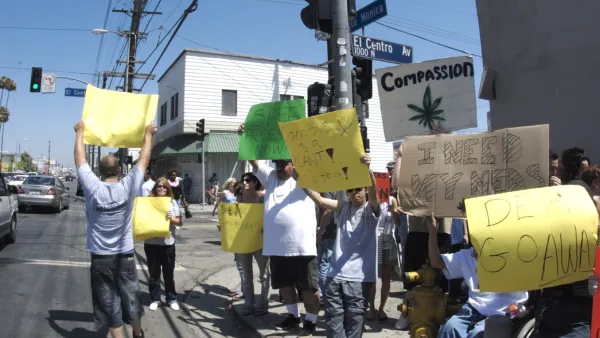
Over 500 Medical Marijuana Shops Shuttered in Los Angeles
In Los Angeles, Proposition D has done its job over the past two years, putting a damper on new medical marijuana shops and dispensaries. Meanwhile, California inches toward decriminalization.
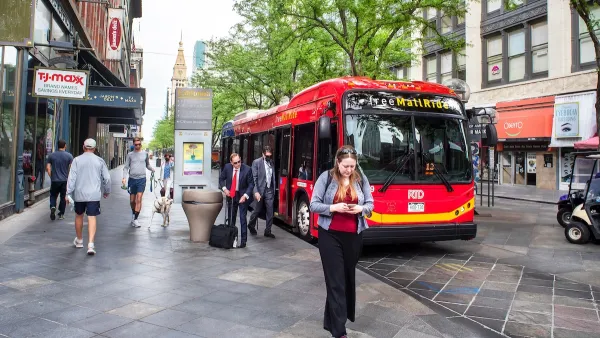
One of Denver’s busiest corridors to gain BRT
The project will span 18 miles and contain 74 bus rapid transit stations.

Planetizen Federal Action Tracker
A weekly monitor of how Trump’s orders and actions are impacting planners and planning in America.

California plans to bury El Niño’s downpour
If the state plays its cards right, it may be able to store a billion acre-feet of El Niño’s water in aquifers.

Desperate measures: Advocates weigh draining Lake Powell to fill Colorado River
Draining the reservoir could reduce evaporation losses by a couple hundred thousand acre-feet.

In Texas, data centers are swallowing promised parkland
Residents who moved to Taylor, Texas for a rural community now have to contend with three data centers in their backyard.

How a Chicago-sized wind farm beat the odds and powered on
The project spanned five presidential administrations and a standoff with a U.S. military base.

MTA gives itself 30 days to transform pit into basketball court
The site has been under construction since 2022; the city originally estimated it would finish the court in 2024.

FREE Course: Walkable City 1: Why Walkability?
After describing his path towards focusing on walkability as the essence of good planning, Jeff Speck marches through his five principal reasons for making more walkable places.
Reinventing Malls: Planning Alchemy—Turning Gray Fields Into Gold
The course focuses on the opportunities and imperatives that shape reinvention of mall sites.

City of Rosemead
Rutgers University, Edward J. Bloustein School of Planning and Public Policy
One Hundred Miles
Hunter College, City University of New York (CUNY)
The Architects Foundation
University of Cincinnati Online
City of Cambridge
Montrose County
The Pocatello Development Authority