Jewish communities in Los Angeles, though well served by public transit, tend to shy away from buses and trains. It's a familiar trend that's due for a change.


An article by Joel Epstein begins by noting the massive expansion projects for Metro service currently underway around Los Angeles County, as well as the robust service already available in neighborhoods home to large Jewish communities, "like Valley Village, which benefits from the Metro Orange Line busway on Chandler Boulevard, and Cheviot Hills and Rancho Park/Westwood, which will benefit in a year or so from the Expo Line extension."
Yet, according to Epstein, "the challenge remains getting people to ride those buses and trains. And given the economics of Los Angeles, that challenge is probably nowhere greater than in the Jewish community. With Jews in Los Angeles on the whole better off economically than other Angelenos, many still suffer from the common misperception that buses and trains are not for them."
What follows is a brief survey of Los Angeles development history, from the nadir chronicled by Mike Davis' City of Quartz to the current urban revival at the hyperlocal level in places like Highland Park, Koreatown, and Echo Park. Epstein concludes with an impassioned plea to explore the benefits of public transit: "If you are one of those holdouts who has not been on a bus or train in Los Angeles recently, you are doing yourself a disservice."
Read the full story: Stop waiting for the bus

Stimulus Funds Not Enough to Guarantee Transit's Future in D.C. and L.A.
In statements that echo the alarm of March 2020, transit officials in Los Angeles and Washington, D.C. recently announced plans to reduce transit service.
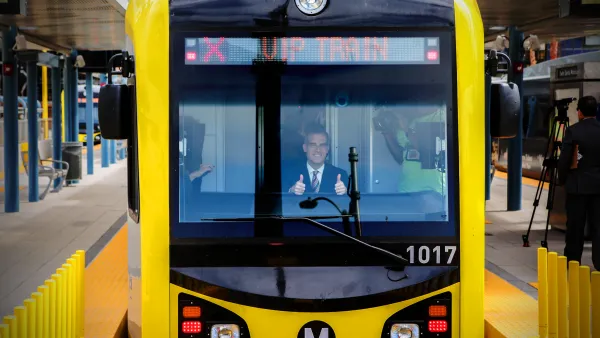
From April to May in L.A.: From a Green New Deal to Transit Service Cuts
Can Los Angeles convince drivers to cut the number of automobile trips in half while also transit frequency on several light rail lines?
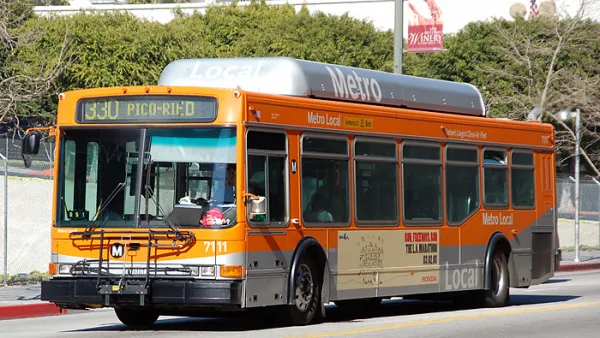
Transit Needs Improvements Sooner Rather Than Later
The Los Angeles transit system is losing riders, but L.A. Metro has been slow to implement changes that could keep people using it.

Desperate measures: Advocates weigh draining Lake Powell to fill Colorado River
Draining the reservoir could reduce evaporation losses by a couple hundred thousand acre-feet.

Eastern Nebraska is running out of electricity
Data centers and electrification are straining eastern Nebraska’s grid, throttling economic development.

Move over, LA: St. Louis gears up for Olympics, invests millions in downtown redevelopment
The Missouri city will host the 2028 Olympic soccer group stage and knockout matches.

Mass. votes against statewide minimum lot size for single-family homes
Over 2 million residents voted on Question 7; it was decided by just over 30,000 votes.

Maryland’s $15 billion bridge project gains key approval
The Maryland Transit Authority said the project will create over 60,000 jobs and add $23 billion to the local economy.

‘No clear next steps’ for Chicago's permanent festival grounds
Eleventh Ward Ald. Nicole Lee has suggested Soldier Field as a possible location for the permanent event space.

FREE Course: Walkable City 1: Why Walkability?
After describing his path towards focusing on walkability as the essence of good planning, Jeff Speck marches through his five principal reasons for making more walkable places.
Reinventing Malls: Planning Alchemy—Turning Gray Fields Into Gold
The course focuses on the opportunities and imperatives that shape reinvention of mall sites.

City of Rosemead
Rutgers University, Edward J. Bloustein School of Planning and Public Policy
One Hundred Miles
University of Michigan School for Environment and Sustainability (SEAS)
Hunter College, City University of New York (CUNY)
The Architects Foundation
City of Cambridge
Montrose County
The Pocatello Development Authority