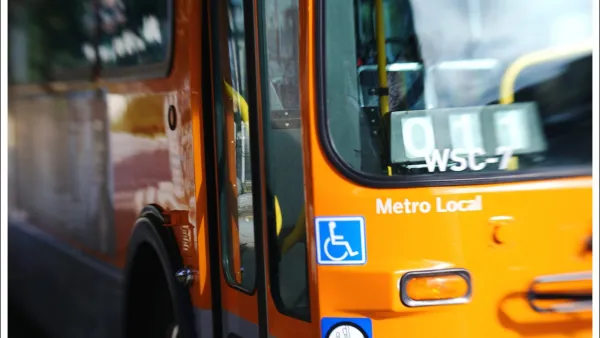
Phillip Washington will leave his role as CEO of the Denver Regional Transportation District to take the same position at the Los Angeles County Metropolitan Transportation Authority.


"The head of Denver’s Regional Transportation District was named today as CEO of the [Los Angeles County] Metropolitan Transportation Authority," reports the City News Service.
Phillip Washington has served as the CEO of Denver's transit systems since 2009. He also spent 24 years of his career in the U.S. Army.
Under Washington's leadership, Denver developed the FasTracks program, "one of the largest voter-approved transit expansion programs in the U.S." Washington also has a track record of ahead-of-schedule and under budget performance: "RTD’s West Line Rail was finished eight months early and came in under budget. The Denver Union Station was completed five months ahead of time under Washington’s direction."
Washington's tenure at Metro will begin in a time of rapid expansion, with five rail projects under construction since 2013.
Read the full story: Former head of Denver’s transit system new CEO of Metro

Opinion: L.A. Metro Bus Plan Must Put Riders First
A bold proposal to overhaul the region’s bus system will require leaders and government officials who will commit to putting the needs of riders front and center.

L.A. Metro Report Examines How Women Travel
Findings from a new study about the mobility needs and concerns of women in Los Angeles will inform future initiatives and planning.

Thinking Outside of the Transit Box in L.A.
Metro is analyzing new geolocational data to look beyond conventional understandings of travel behavior.

Planetizen Federal Action Tracker
A weekly monitor of how Trump’s orders and actions are impacting planners and planning in America.

California plans to bury El Niño’s downpour
If the state plays its cards right, it may be able to store a billion acre-feet of El Niño’s water in aquifers.

Chicago breaks ground on $3 billion megadevelopment
The new neighborhood, titled Foundry Park, will one day host 3,700 residences.

California High-Speed Rail Authority CEO resigns after $600,000 scandal
Under Ian Choudri, the authority used taxpayer dollars to fund first class flights and trips to nightclubs.

Want to study the Missouri River? Soon, you may need unanimous approval from 10 states
Legislation would require 10 governors’ permission to study or build projects moving water outside the basin.

Desperate measures: Advocates weigh draining Lake Powell to fill Colorado River
Draining the reservoir could reduce evaporation losses by a couple hundred thousand acre-feet.

FREE Course: Walkable City 1: Why Walkability?
After describing his path towards focusing on walkability as the essence of good planning, Jeff Speck marches through his five principal reasons for making more walkable places.
Reinventing Malls: Planning Alchemy—Turning Gray Fields Into Gold
The course focuses on the opportunities and imperatives that shape reinvention of mall sites.

City of Rosemead
Rutgers University, Edward J. Bloustein School of Planning and Public Policy
One Hundred Miles
Hunter College, City University of New York (CUNY)
The Architects Foundation
University of Cincinnati Online
City of Cambridge
Montrose County
The Pocatello Development Authority