The Metropolitan Transportation Commission—the Bay Area's regional transportation planning agency—recently did fans of data and mapping a huge favor and launched a website called Vital Signs.


"Data lovers can now nerd out on a new website that collects Bay Area transportation data and puts it into customizable maps and charts that anyone can play with," reports Melanie Curry.
The website, called Vital Signs, is part of an open data project by the Metropolitan Transportation Commission (MTC), and could inform measurements if/when the beleaguered Plan Bay Area effort begins to shape the region.
"The first rollout of the website includes transportation data from a variety of sources, including the US Census. Land use data will be added in March. Information and measures of the economy–job creation, employment, and housing affordability–and environment—emissions, fuel sales, injuries from collisions–will complete the website by June," according to Curry's sources with the MTC.
Curry goes on to detail some of the uses of the portal, including comparisons between San Francisco and Los Angeles on measures of annual and daily transit ridership.
Members of the mainstream have already picked up on the tools available through Vital Signs, including Gary Richards for the Contra Costa Times and Ann Notarangelo for CBS SF Bay Area.
Read the full story: New Data Website Tracks Bay Area Vital Signs

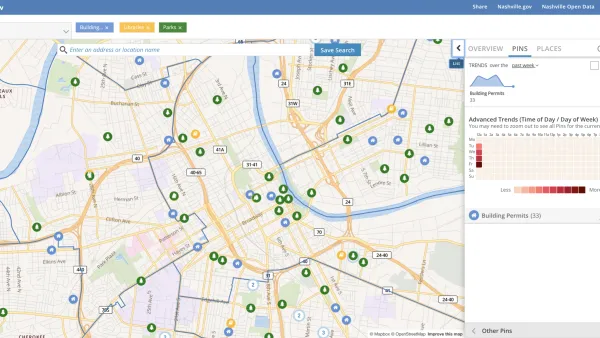
Presenting Municipal Data in an Interactive Map, Nashville Style
The city of Nashville launched the NashView interactive data map earlier this month.

DataUSA: An Intuitive Tool for Public Data
A collaboration between Deloitte, Datawheel, and MIT has produced an intuitive aesthetically-pleasing gathering point for public data in the United States. Specific locations and industries boast easy-to-read profiles.
Putting Alternative Fuel Stations on the Map
Yesterday, the U.S. Department of Energy released an interactive map displaying thousands of alternative fuel stations around the nation.

Planetizen Federal Action Tracker
A weekly monitor of how Trump’s orders and actions are impacting planners and planning in America.

California plans to bury El Niño’s downpour
If the state plays its cards right, it may be able to store a billion acre-feet of El Niño’s water in aquifers.

Chicago breaks ground on $3 billion megadevelopment
The new neighborhood, titled Foundry Park, will one day host 3,700 residences.

Satanic place names
From streams and lakes to valleys and canyons, I mapped more than 1,000 places named after the Devil.

California High-Speed Rail Authority CEO resigns after $600,000 scandal
Under Ian Choudri, the authority used taxpayer dollars to fund first class flights and trips to nightclubs.

Want to study the Missouri River? Soon, you may need unanimous approval from 10 states
Legislation would require 10 governors’ permission to study or build projects moving water outside the basin.

FREE Course: Walkable City 1: Why Walkability?
After describing his path towards focusing on walkability as the essence of good planning, Jeff Speck marches through his five principal reasons for making more walkable places.
Reinventing Malls: Planning Alchemy—Turning Gray Fields Into Gold
The course focuses on the opportunities and imperatives that shape reinvention of mall sites.

City of Rosemead
Rutgers University, Edward J. Bloustein School of Planning and Public Policy
One Hundred Miles
Hunter College, City University of New York (CUNY)
The Architects Foundation
University of Cincinnati Online
City of Cambridge
Montrose County
The Pocatello Development Authority