Since the 1980s, California has been both a beacon of cutting-edge urban policy and an example of the ways planning can go awry.



Bill Fulton is in a position to consider California's progress, after an extraordinarily prominent career as a mainstay of the state's city planning and civic community—from mayor of Ventura to director of San Diego’s Planning Department. Recently chosen to lead Rice University’s Kinder Institute for Urban Research in Houston, Fulton reflects as he prepares to leave the state.
In an interview with TPR, he characterizes planning in San Diego, then goes on to discusses the dissolution of community redevelopment agencies: "I was critical of redevelopment before, because I thought it was abused too much and used too widely. I think it will come back in a more targeted form around transit stations eventually. I would welcome that. In the meantime, it’s been very difficult to put the pieces together."
Fulton also comments on the evolution of "smart growth": "Now that I have been deeply embroiled in the day-to-day dealings over CEQA in San Diego, for me 'smart growth' has come to mean making sure that people have access to the things they want and need on a daily basis in their neighborhood. That’s not how we analyze plans and projects under CEQA. We try to figure out whether we will need another left-turn lane in 30 years. I like that 'smart growth' encompasses a variety of ideas about proximity, convenience, and location...I think in our society there’s a much greater taste for urban, or at least village-style, or at least walkable living than there was 20 years ago."
Read the full story: Bill Fulton’s Exit Reflections on San Diego City Planning
Bill Fulton On What It Will Take to Rebuild San Diego's Planning Department
Bill Fulton, noted Smart Growth advocate and Director of Planning for the City of San Diego, looks to rebuild a department and pass community plans in the wake of San Diego's leadership crisis. In this interview, he describes the path ahead.

Learning loss and urban schools, part 2
Did test scores in progressive cities drop more post-COVID than test scores in moderate ones?
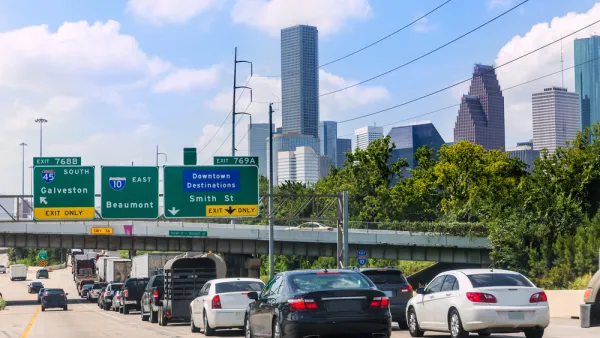
Houston’s Equity Score Leaves Room for Improvement
Houston is an international city, with a diverse population and economy. Its equity indicators, however, are relatively average compared to other U.S. cities.

Desperate measures: Advocates weigh draining Lake Powell to fill Colorado River
Draining the reservoir could reduce evaporation losses by a couple hundred thousand acre-feet.

Eastern Nebraska is running out of electricity
Data centers and electrification are straining eastern Nebraska’s grid, throttling economic development.

Malls are becoming the midtowns of the future
Mall and office park redevelopments are a generational opportunity to create new nodes of urbanity.

NYC breaks ground on anti-flooding infrastructure project
New York City's new system will reduce stormwater flows to local sewers by 90%.

One Kentucky town’s secret to affordable housing
The Smoketown Community Land Trust has already built seven affordable homes for community members.

Houston gains petal-shaped cooling infrastructure to make streets more ‘delightful’
The city has installed the pavilions along 15 blocks in Houston.

FREE Course: Walkable City 1: Why Walkability?
After describing his path towards focusing on walkability as the essence of good planning, Jeff Speck marches through his five principal reasons for making more walkable places.
Reinventing Malls: Planning Alchemy—Turning Gray Fields Into Gold
The course focuses on the opportunities and imperatives that shape reinvention of mall sites.

City of Rosemead
Rutgers University, Edward J. Bloustein School of Planning and Public Policy
One Hundred Miles
University of Michigan School for Environment and Sustainability (SEAS)
Hunter College, City University of New York (CUNY)
The Architects Foundation
City of Cambridge
Montrose County
The Pocatello Development Authority