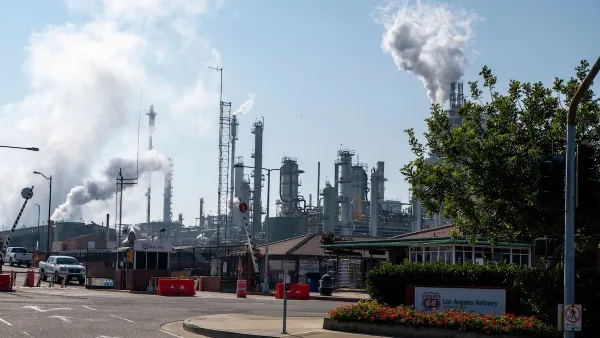
The world's largest emitter of CO2, China, has adopted a cap-and-trade program would open the world's largest carbon market as early as 2016.


With a headline that includes the words "Now We're Really Out of Excuses," it's clear that James West's coverage of China's cap-and-trade program is implying a deficit of regulation here in the United States. However, most of the coverage comes in the form of infographics that explain "why China is doing this now, and what we know about the plan so far."
Perhaps the key factoid presented by the infographics: "China Aims to cut its 'carbon intensity—the CO2 it emits for each unit of GDP—by 40-45 percent from 2005 levels by 2050."
Read the full story: China Just Got Serious About Global Warming. Now We're Really Out of Excuses.
California’s Cap and Trade Program Up in the Air
The state’s carbon trading program is being attacked as ineffective from one side and overly onerous from the other.

Mexico to Pilot Carbon Pricing
The year-long program will begin in November, laying a foundation for a national carbon market.

FTA Kills ‘Social Cost of Carbon’ in Transit Grant Criteria
The Capital Investments Grant program will no longer factor in the future impacts of carbon emissions.

Desperate measures: Advocates weigh draining Lake Powell to fill Colorado River
Draining the reservoir could reduce evaporation losses by a couple hundred thousand acre-feet.

Eastern Nebraska is running out of electricity
Data centers and electrification are straining eastern Nebraska’s grid, throttling economic development.

Malls are becoming the midtowns of the future
Mall and office park redevelopments are a generational opportunity to create new nodes of urbanity.

NYC breaks ground on anti-flooding infrastructure project
New York City's new system will reduce stormwater flows to local sewers by 90%.

One Kentucky town’s secret to affordable housing
The Smoketown Community Land Trust has already built seven affordable homes for community members.

Houston gains petal-shaped cooling infrastructure to make streets more ‘delightful’
The city has installed the pavilions along 15 blocks in Houston.

FREE Course: Walkable City 1: Why Walkability?
After describing his path towards focusing on walkability as the essence of good planning, Jeff Speck marches through his five principal reasons for making more walkable places.
Reinventing Malls: Planning Alchemy—Turning Gray Fields Into Gold
The course focuses on the opportunities and imperatives that shape reinvention of mall sites.

City of Rosemead
Rutgers University, Edward J. Bloustein School of Planning and Public Policy
One Hundred Miles
University of Michigan School for Environment and Sustainability (SEAS)
Hunter College, City University of New York (CUNY)
The Architects Foundation
City of Cambridge
Montrose County
The Pocatello Development Authority