Most North American urbanists turn to Europe for inspiration and direction. Some of that brilliance, Ben Brown reminds us, is due to time and distance.


"The places you’re visiting were working their way through human settlement and mobility successes and flops for a thousand or more years before automobiles entered the conversation. Amsterdam was already a mature, globally important city when America’s colonies of immigrants were struggling towards organizing themselves into an independent republic. Even the oldest American cities have spent at least a quarter of their histories planning for the care and feeding of cars."
“'Don’t you think,' she asked, 'it will take a few generations to reverse that?'”
"So time is a component we impatient Americans often fail to factor into our change equations. Here’s another one: Distance."
"The hassle-free hop from Amsterdam to Berlin reminded me how geographically compacted are Europe’s countries. Consider: There are fewer miles separating Paris, Berlin, Amsterdam, Zurich, Brussels or Luxembourg in Europe than New York City and Atlanta in our country. Yet until recently, the Europeans’ proximity didn’t prevent thousands of years of violent conflicts. And even now, the transition into a true European Union is an uneasy one."
Read the full story: Euro-Envy Reconsidered: Talkin’ time, distance and change

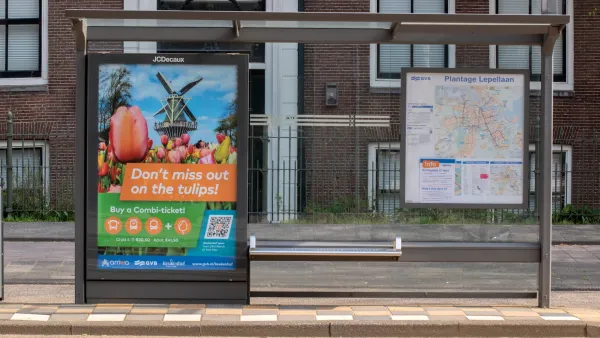
Amsterdam is First World Capital to Ban Ads for Fossil Fuels on Public Infrastructure
Several other Dutch cities have banned advertising for harmful or polluting industries on city-owned properties.

Cities Are Interested in Adopting Generative AI. What’s Stopping Them?
Only a fraction of cities interested in using generative artificial intelligence to enhance how they operate have made moves to adopt to the technology. What are the obstacles to adoption and what can be learned from local governments who’ve already taken the leap?
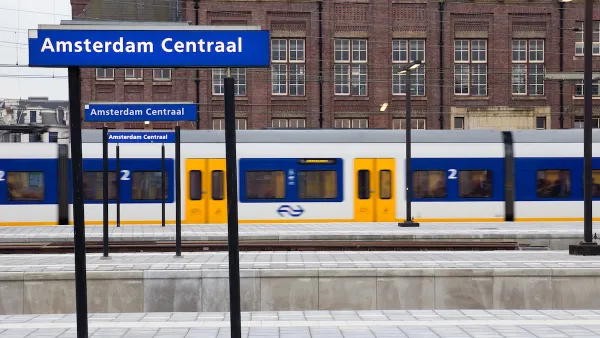
Eurostar Temporarily Closing Two High-Speed Rail Routes
Eurostar is temporarily closing routes from London to Disneyland Paris and London to Amsterdam.

Planetizen Federal Action Tracker
A weekly monitor of how Trump’s orders and actions are impacting planners and planning in America.

California plans to bury El Niño’s downpour
If the state plays its cards right, it may be able to store a billion acre-feet of El Niño’s water in aquifers.

Chicago breaks ground on $3 billion megadevelopment
The new neighborhood, titled Foundry Park, will one day host 3,700 residences.

Want to study the Missouri River? Soon, you may need unanimous approval from 10 states
Legislation would require 10 governors’ permission to study or build projects moving water outside the basin.

Desperate measures: Advocates weigh draining Lake Powell to fill Colorado River
Draining the reservoir could reduce evaporation losses by a couple hundred thousand acre-feet.

This road in NYC is infamously dangerous — and Mamdani can't fix it
New York City's Ocean Parkway is known for reckless driving, but the power to implement safety measures lies with the state rather than the city.

FREE Course: Walkable City 1: Why Walkability?
After describing his path towards focusing on walkability as the essence of good planning, Jeff Speck marches through his five principal reasons for making more walkable places.
Reinventing Malls: Planning Alchemy—Turning Gray Fields Into Gold
The course focuses on the opportunities and imperatives that shape reinvention of mall sites.

City of Rosemead
Rutgers University, Edward J. Bloustein School of Planning and Public Policy
One Hundred Miles
Hunter College, City University of New York (CUNY)
The Architects Foundation
University of Cincinnati Online
City of Cambridge
Montrose County
The Pocatello Development Authority