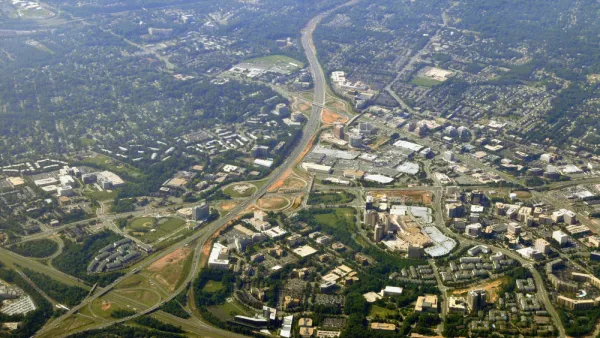
CityLab provides an in-depth analysis of the planning efforts surrounding the D.C. Metro's forthcoming Silver Line in Tysons Corner, Virginia. At stake, according to the article: "the future of the American suburb as we know it."


Chris Klimek focuses on Tysons, which adopted a Comprehensive Plan Amendment for the Tysons Corner Urban Center. "What makes Tysons' 40-year urbanization plan of national interest," according to Klimek, "is the area's sheer size and car-centric character."
"The current plan for Tysons, adopted in 2010, envisions 100,000 residents and twice as many daytime workers by 2050," so "[in] other words, the 40-year plan is less a facelift than a full-body transplant."
To undergo this radical transformation, "Fairfax County has said it wants at least three-quarters of new development planned for Tysons to occur within a half-mile of one of its four Silver Line stations. Another 45 million square feet of construction is planned for the coming decades, one of the largest construction projects on the East Coast."
Read the full story: The Colossal Expectations of D.C.'s Newest Metro Line

D.C.'s New Metro Line Already Influencing the Suburbs
The Silver Line opened two and a half months ago. Already, with strong ridership in both directions, some businesses are seeing new opportunities.
D.C. Metro's Silver Line Launches Passenger Service
After no small amount of debate, delay, and controversy, the first phase of D.C. Metro's Silver Line will launch passenger service today. The line will connect Washington D.C. to northwestern Virginia, including four stops in Tysons Corner.

D.C. Metro Plans Ambitious Expansion Despite Financial Woes
Facing a $750 million ‘fiscal cliff,’ the agency says it’s important to continue looking forward to ‘visionary’ future plans.

Planetizen Federal Action Tracker
A weekly monitor of how Trump’s orders and actions are impacting planners and planning in America.

California plans to bury El Niño’s downpour
If the state plays its cards right, it may be able to store a billion acre-feet of El Niño’s water in aquifers.

Chicago breaks ground on $3 billion megadevelopment
The new neighborhood, titled Foundry Park, will one day host 3,700 residences.

California High-Speed Rail Authority CEO resigns after $600,000 scandal
Under Ian Choudri, the authority used taxpayer dollars to fund first class flights and trips to nightclubs.

Want to study the Missouri River? Soon, you may need unanimous approval from 10 states
Legislation would require 10 governors’ permission to study or build projects moving water outside the basin.

Desperate measures: Advocates weigh draining Lake Powell to fill Colorado River
Draining the reservoir could reduce evaporation losses by a couple hundred thousand acre-feet.

FREE Course: Walkable City 1: Why Walkability?
After describing his path towards focusing on walkability as the essence of good planning, Jeff Speck marches through his five principal reasons for making more walkable places.
Reinventing Malls: Planning Alchemy—Turning Gray Fields Into Gold
The course focuses on the opportunities and imperatives that shape reinvention of mall sites.

City of Rosemead
Rutgers University, Edward J. Bloustein School of Planning and Public Policy
One Hundred Miles
Hunter College, City University of New York (CUNY)
The Architects Foundation
University of Cincinnati Online
City of Cambridge
Montrose County
The Pocatello Development Authority