Motorists will not legally be required to provide a three-foot distance when they pass cyclists as a consequence of Brown's veto of SB 910. Comparisons were made to Texas Gov. Rick Perry who had vetoed a a similar bill in 2009.


Stunning the bicycle community, the Governor chose to adhere to the advice of Caltrans and the California Highway Patrol in believing that such a law could cause crashes and traffic back-ups.
"In his veto message, Brown writes, "Caltrans and the California Highway Patrol have raised legitimate concerns about other provisions such as the 15 MPH requirement. On streets with speed limits of 35 or 40 MPH, slowing to 15 MPH to pass a bicycle could cause rear end collisions. On other roads, a bicycle may travel at or near 15 MPH creating a long line of cars behind the cyclist."
From CA Bicycle Coaltion: CBC refutes CHP speculation that SB 910 will cause collisions: "Andy Clarke, president of the League of American Bicyclists, the nation's oldest bicycling advocacy organization, wrote this week in a letter to Gov. Brown, "In our experience working with the 19 [sic] other states that have passed three-foot passing laws, we have heard of no increases in the number of motor vehicle crashes due to the new requirements or any increased burden on law enforcement. In contrast, we have received nothing but positive responses to these laws."
It remains to be seen if California cyclists react as strongly to Brown's veto as their counterparts in Texas did to Perry's veto and launch "a petition drive asking voters to keep him in mind during the election - and not in a good way." [ Perry was to face U.S. Sen. Kay Bailey Hutchison, R-Texas, in the GOP gubernatorial primary the next year.]
Thanks to SF. Streetsblog
Read the full story: Brown Vetoes 3 Foot Passing Law

Finally, California Has a Safe-Passing Law!
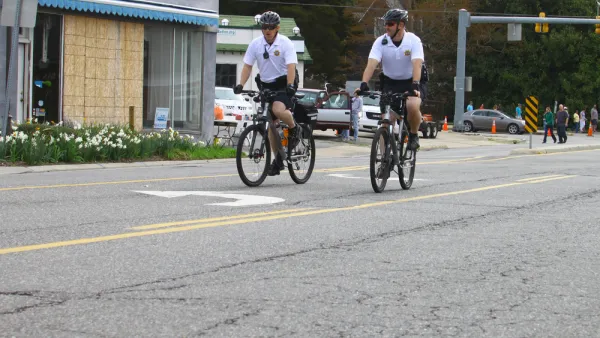
Good news for all cyclists riding on Calif. roadways came from Gov. Jerry Brown on Monday when he attached his signature to a bill making it law that drivers give bicyclists at least 3 feet of space when passing from behind - only took him 5 years!
Protected Bicycle Lanes Now Welcome in California
Thanks to California Gov. Jerry Brown signing San Francisco Assemblyman Phil Ting's "bikeways" bill on Sept. 20, expect to see many more protected bike lanes constructed by cities throughout the state. Another signed bill will increase bike funding.
Virginia's Proposed Bicycle Safety Act Puts the Onus on Drivers
Three-foot passing rules are safe. Requiring drivers to change lanes to pass people on bikes are even safer.

Planetizen Federal Action Tracker
A weekly monitor of how Trump’s orders and actions are impacting planners and planning in America.

Amtrak, CN end decades-long dispute with eight-year agreement
The new operating agreement establishes an updated framework for the companies to work together, including processes to resolve disputes.

Judges permit Denver to divert 77,000 acre feet from the Colorado River for reservoir expansion
Overuse and climate change have caused the Colorado River’s water levels to plummet.

NYC DOT wants faster, more permanent street upgrades
The city is examining ways to build more concrete infrastructure without getting entangled in 'decades-long' projects.

'Something we’ve never seen before:' rising utility rates could strain city finances nationwide
Data centers, climate change and other factors have caused utility rates in the United States to increase by 38% since 2020.

Trump to overrule local leaders, lease millions of acres of America’s Pacific Island territories’ seafloors to mining companies
International law says that the Indigenous people of America’s territories have a right to prior and informed consent regarding projects that impact their countries.

FREE Course: Walkable City 1: Why Walkability?
After describing his path towards focusing on walkability as the essence of good planning, Jeff Speck marches through his five principal reasons for making more walkable places.
Reinventing Malls: Planning Alchemy—Turning Gray Fields Into Gold
The course focuses on the opportunities and imperatives that shape reinvention of mall sites.

Harvard University Graduate School of Design
KFH Group Inc.
Greater Baltimore Committee
The Architects Foundation
University of Cincinnati Online
The Pocatello Development Authority
The Urban Renewal Agency of the City of Pocatello