Gary Richards, the Roadshow columnist for the San Jose Mercury News, provides many examples of redesigning streets for bikes, peds, and transit throughout the Bay Area, a direct result of the 2008 California Complete Streets legislation.


"Across the Bay Area and California, cities are removing or narrowing lanes and redesigning hundreds of streets to add bike lanes, speed up transit and improve pedestrian safety.
The car remains king, but the crown is slipping.
Some changes began years ago, but the push toward "road diets," as transportation planners call them, took off in 2008, when the state endorsed the concept of "complete streets" for urban neighborhoods in which the entire streetscape, from sidewalk to sidewalk, is geared for safe access and use by nondrivers."
Richards highlights conversion of one-way to two-way streets in downtown San Jose to reduce traffic speeds, a lane 'taking' by a bus rapid transit system in preliminary engineering in San Jose, and street 'makeovers' in the many smaller cities in the Bay Area as well as San Francisco and Oakland. As Hans Larsen, director of San Jose's Dept. of Transportation summarizes, "For decades, planning has focused on the efficient movement of cars. The result has been communities that are dependent on cars and are not conducive to walking and biking and transit."
No longer.
Thanks to National Complete Streets Coalition
Read the full story: Across the Bay Area, streets are getting a makeover -- with less room for cars
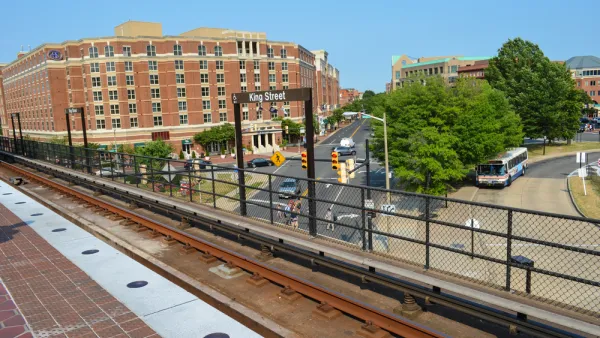
Bus Rapid Transit, Bike Lanes Under Consideration in Alexandria, Virginia
A complete streets makeover is taking shape for Duke Street in Alexandria.
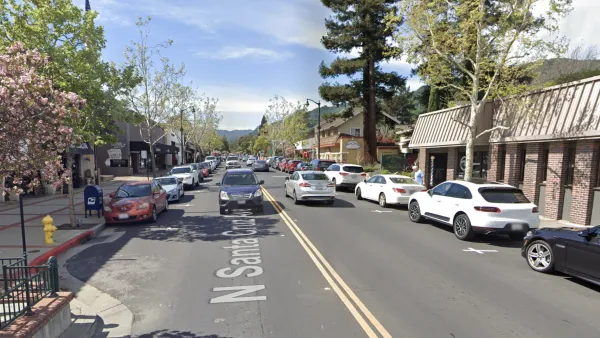
Public Opinion Differs on New Bay Area Road Diet
Some love it; some hate it: The main drag of Downtown Los Gatos, at the southern end of the South Bay Area, got a complete streets makeover.
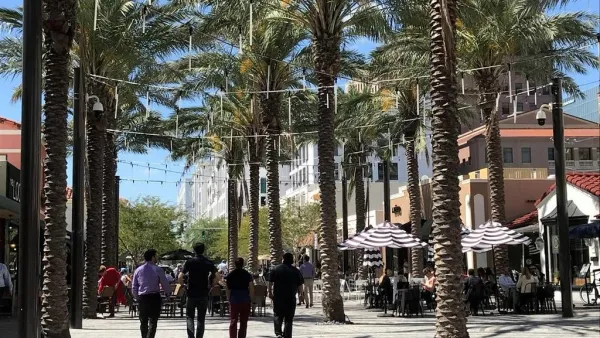
A Dutch 'Shared Street' Is Coming To Miami
A Dutch-style "shared street" is being planned in the Wynwood neighborhood of Miami.

Planetizen Federal Action Tracker
A weekly monitor of how Trump’s orders and actions are impacting planners and planning in America.

Eastern Nebraska is running out of electricity
Data centers and electrification are straining eastern Nebraska’s grid, throttling economic development.

Washington state to charge fee to drivers with fuel-efficient cars
Revenue from the fee will go towards supporting the state’s highways.

Instead of building new housing, LA developers are turning mansions into mega-mansions
In the richest areas, the number of houses valued at $30 million with demolition permits has skyrocketed since 2018.

Illinois considers spending $1 billion in taxpayer money on data center
A quantum computing campus and data center are currently under construction in Chicago.

As development costs rise, Boston moves to lessen affordable housing requirements
The Boston Zoning Commission and the City Council still need to approve Boston Mayor Michelle Wu’s proposed changes

FREE Course: Walkable City 1: Why Walkability?
After describing his path towards focusing on walkability as the essence of good planning, Jeff Speck marches through his five principal reasons for making more walkable places.
Reinventing Malls: Planning Alchemy—Turning Gray Fields Into Gold
The course focuses on the opportunities and imperatives that shape reinvention of mall sites.

City of Charlotte
City of Rosemead
Rutgers University, Edward J. Bloustein School of Planning and Public Policy
University of Michigan School for Environment and Sustainability (SEAS)
Hunter College, City University of New York (CUNY)
The Architects Foundation
University District Partnership
City of Cambridge
The Pocatello Development Authority