Large investors are quietly buying up dozens of properties in Altadena, California, where a devastating wildfire destroyed more than 6,000 homes in January.


Corporations are quietly buying up fire-ravaged properties in Altadena, California, where January’s Eaton Fire claimed over 6,000 homes, according to an article by Yoonj Kim in Dwell.
Of the nearly 150 homes that have sold since the fire, Kim found that at least half were bought by corporate entities. “This on its own isn’t inherently alarming, as individuals can purchase property through LLCs to limit legal exposure. But it is a rate that far exceeds the national average, where corporate buyers account for roughly 23 percent of single-family home sales.” However, Kim notes that “the concentration of ownership points to a pattern of land consolidation that warrants attention—particularly in a community still recovering from disaster.”
Kim details the top corporate buyers of Altadena properties, which include Black Lion Properties, LLC, a newly formed company that has purchased almost exclusively post-fire Altadena properties, and Ocean Development Inc., which currently develops affordable housing in South LA. Other buyers are more concerning, such as Virtua Capital Management, which “was the subject of an SEC proceeding for failing to disclose conflicts of interest and double-dipping on real estate deals they weren’t supposed to profit from.”
Kim notes that institutional investment in housing is growing around the country. “This trend is associated with declining homeownership rates and rising rents, particularly in working-class or destabilized areas. Wall Street and private equity have increasingly targeted working-class neighborhoods, often after moments of destabilization.”
The companies named in the article did not reply to requests for comment or did not have publicly available contact information. “In the end, the lack of response echoed the larger pattern—underscoring the secrecy surrounding these acquisitions, and the walls that often go up when trying to follow the money.”
FULL STORY: The Corporations Quietly Buying Up Altadena

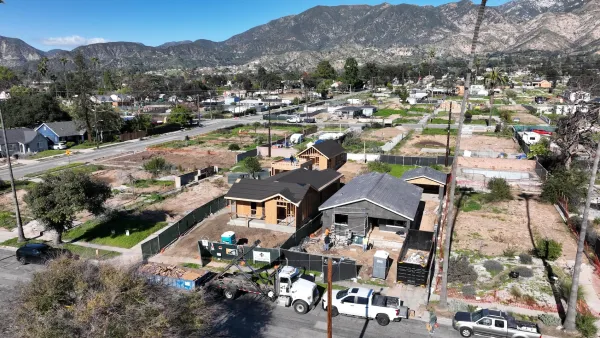
Almost 40% of LA fire survivors face a housing crisis
Many Angelenos who lost their homes in the Altadena and Pacific Palisades fires have already run out of temporary housing funds.
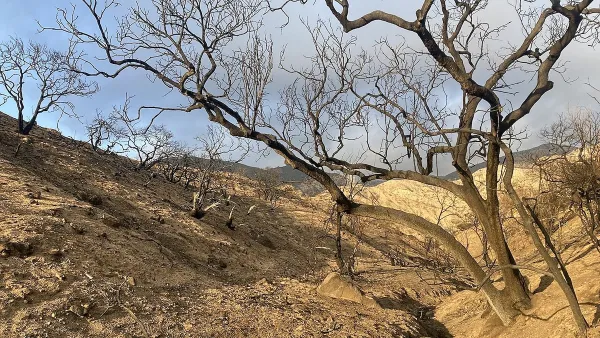
Preserving Altadena’s Trees: A Community Effort to Save a Fire-Damaged Landscape
In the wake of the Eaton Fire, Altadena Green is working to preserve fire-damaged but recoverable trees, advocating for better assessment processes, educating homeowners, and protecting the community’s urban canopy from unnecessary removal.

UCLA Experts Offer Critical Support for LA Wildfire Response and Recovery
The UCLA Luskin Center for Innovation offers expert guidance on LA wildfire response and recovery, addressing critical issues like water safety, air quality, equitable rebuilding, and climate adaptation to promote resilience and sustainability.

The state-sanctioned urbicide of Austin
People don’t kill cities. Freeways do.

US to reduce Colorado River water deliveries to Mexico
A new Colorado Treaty amendment reduces Mexico’s Colorado River water allocation by 250,000 acre feet.

New Jersey’s second-largest city bans standalone data centers
Jersey City will continue to allow co-location facilities, such as those meant for research institutions that store their own data.

Amtrak not solely to blame for New Jersey commuter rail's unreliability, report finds
A new study from the Garden State Initiative found that NJ Transit’s budget grew 20% across a 4 year period, but reliability declined significantly over the same period.

EPA erases limits on planet-warming pollution from power plants
Under Monday’s plan, power plants would still have some limits on how much mercury, arsenic and other contaminants they can emit.

Phoenix announces new on-demand transit service, more frequent RAPID buses
Both new services will launch in October, and are part of Phoenix's Project Effective Access Solutions for Easing Congestion.

FREE Course: Walkable City 1: Why Walkability?
After describing his path towards focusing on walkability as the essence of good planning, Jeff Speck marches through his five principal reasons for making more walkable places.
Reinventing Malls: Planning Alchemy—Turning Gray Fields Into Gold
The course focuses on the opportunities and imperatives that shape reinvention of mall sites.


Eagle County Government
Harvard University Graduate School of Design
Nashville Planning Department
The Architects Foundation
University of Cincinnati Online
The Pocatello Development Authority
The Urban Renewal Agency of the City of Pocatello
Journal of the American Planning Association