Cities across the country are breathing new life into abandoned and disused inner city rail lines.


Following on the success of the High Line in New York City, other cities are looking at underused inner city rail lines as opportunities.
"cities around the country, including Chicago, Philadelphia and St. Louis, are working up plans to renovate their aging railroad trestles, tracks and railways for parkland. Cities with little public space are realizing they badly need more parks, and the High Line has taught that renovating an old railway can be the spark that helps improve a neighborhood and attract development.
The High Line's first and second sections cost $153 million, but have generated an estimated $2 billion in new developments. In the five years since construction started on the High Line, 29 new projects have been built or are under way in the neighborhood, according to the New York City Department of City Planning. More than 2,500 new residential units, 1,000 hotel rooms and over 500,000 square feet of office and art gallery space have gone up."
Read the full story: Cities See the Other Side of the Tracks

Reviews and Reflections on the Best New Urban Parks
The New Republic offers a look and review of some of the nation's best new urban parks.
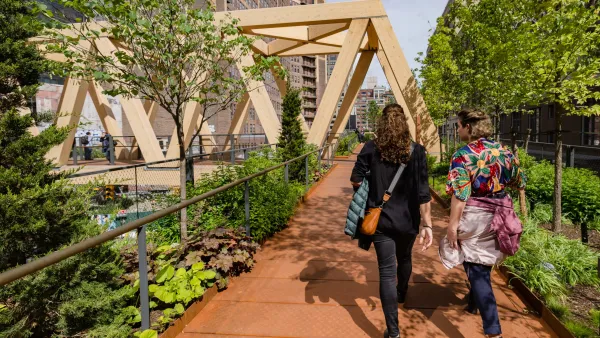
High Line-Moynihan Connector Opens in New York City
Two footbridges now link the High Line park to the most recent expansion of the Penn Station complex, the Moynihan Train Hall.
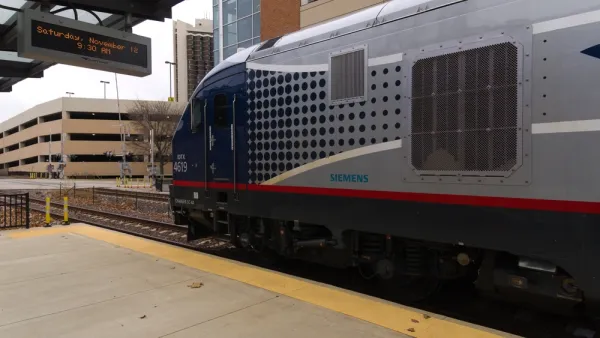
Chicago-St. Louis Corridor Trains Cleared for 110-mph Speeds
Amtrak has final federal approval for train speeds of 110 miles per hour between Joliet and Alton, culminating almost ten years of planning and investing.

Planetizen Federal Action Tracker
A weekly monitor of how Trump’s orders and actions are impacting planners and planning in America.

Amtrak, CN end decades-long dispute with eight-year agreement
The new operating agreement establishes an updated framework for the companies to work together, including processes to resolve disputes.

Northwest rail fans eager for Sept. 30 debut of Amtrak’s Airo fleet
Get ready for that new train smell and more seats. But they won’t go faster or run more frequently on the Cascades route in Washington and Oregon.

Atlanta City Council unanimously backs $3.5 billion Beltline light rail project
The resolution was drafted after Atlanta Mayor Andre Dickens pulled support for the Atlanta Streetcar extension last year.

SEPTA to bring nearby frequent transit to over 1 million new riders as part of decade-long plan
The agency's Accelerate plan will also bring frequent transit to twice the amount of jobs that are currently located near it.

NYC plants over 18,000 trees, the most new foliage in a decade
Many of the trees were planted in communities vulnerable to extreme heat.

FREE Course: Walkable City 1: Why Walkability?
After describing his path towards focusing on walkability as the essence of good planning, Jeff Speck marches through his five principal reasons for making more walkable places.
Reinventing Malls: Planning Alchemy—Turning Gray Fields Into Gold
The course focuses on the opportunities and imperatives that shape reinvention of mall sites.

City of Thousand Oaks
City of Wisconsin Rapids
Harvard University Graduate School of Design
The Architects Foundation
University of Cincinnati Online
The Pocatello Development Authority
The Urban Renewal Agency of the City of Pocatello