Two footbridges now link the High Line park to the most recent expansion of the Penn Station complex, the Moynihan Train Hall.


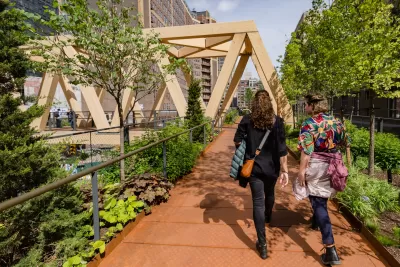
A new pedestrian pathway connects New York City’s High Line to the recently opened Moynihan Train Hall, reports Pansy Schulman in Architectural Record. “Now, one can walk from the High Line’s southern terminus over a mile away in the West Village to the intersection of 9th Avenue and 34th Street (a notoriously inhospitable pedestrian environment) without stepping foot on public pavement.”
“Comprising a pair of footbridges—one lushly planted and the other featuring a dramatic mass-timber truss structure—that float above a tangle of busy roadways, the combined 600-foot-long pedestrian pathway fuses together various components of Manhattan’s Far West Side: the High Line, Hudson Yards, the mixed-use Manhattan West development, and, to the east, the new Moynihan Train Hall.”
Designed by SOM and James Corner Field Operations, the $50 million connector project is a public-private partnership owned by Empire State Development and maintained by the nonprofit Friends of the High Line.
FULL STORY: Manhattan Gains an Elevated Pedestrian Path Linking the High Line with Moynihan Train Hall

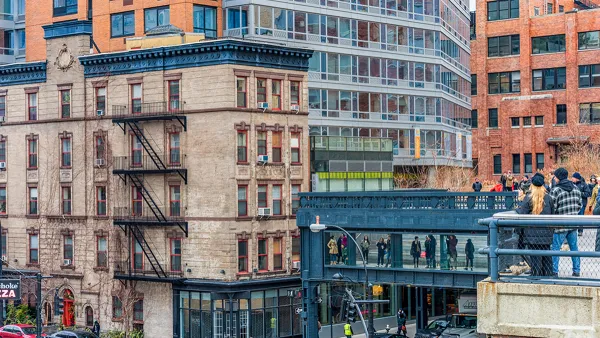
Proposal Would Connect the High Line to the New Moynihan Train Hall
The High Line has a chance to add the role of civic connector to its list of plaudits.
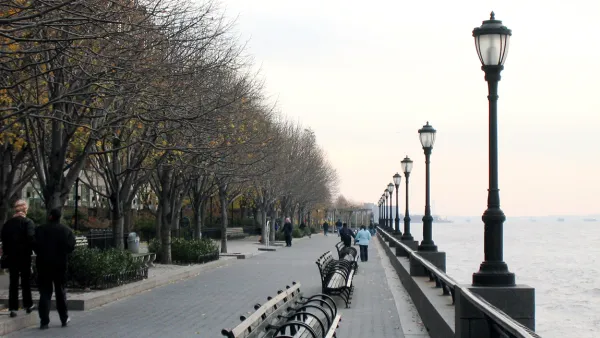
Meet Some of New York City's Newest Parks
In a city where density is everything, these park projects make creative use of existing public spaces—and, in some cases, create their own.
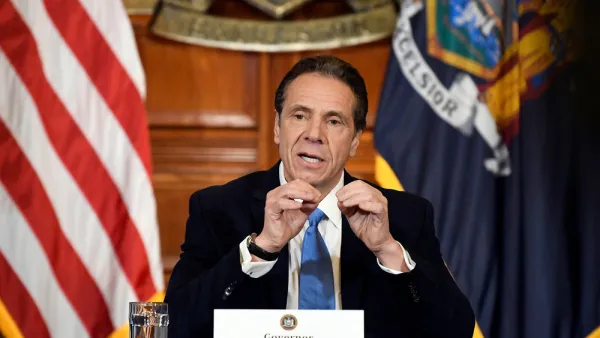
Massive, Expensive Redevelopment of Midtown Manhattan Proposed
New York Governor Cuomo's State of the State speeches last week included an ambitious proposal for a large-scale redevelopment project on Manhattan's west side, adjacent to Penn Station.

Planetizen Federal Action Tracker
A weekly monitor of how Trump’s orders and actions are impacting planners and planning in America.

The state-sanctioned urbicide of Austin
People don’t kill cities. Freeways do.

US to reduce Colorado River water deliveries to Mexico
A new Colorado Treaty amendment reduces Mexico’s Colorado River water allocation by 250,000 acre feet.

Baltimore to break ground on $50 million Transit Priority Project
The project will bring faster bus trips, safer streets and better bike connections to Baltimore.

Airbnb launches $250 million 'last-dollar financing' housing accelerator, makes first investment in Austin
The company will put $6.4 million towards affordable housing development in Texas’ capital.

Guerilla urbanists are building DIY bus stop benches in Chicago
A before-and-after of one of the bus stops with a new bench. The new benches are not officially sanctioned or permitted, but the residents who placed them hope they will be the start of a network of DIY benches across the city.

FREE Course: Walkable City 1: Why Walkability?
After describing his path towards focusing on walkability as the essence of good planning, Jeff Speck marches through his five principal reasons for making more walkable places.
Reinventing Malls: Planning Alchemy—Turning Gray Fields Into Gold
The course focuses on the opportunities and imperatives that shape reinvention of mall sites.

Eagle County Government
Harvard University Graduate School of Design
Nashville Planning Department
The Architects Foundation
University of Cincinnati Online
The Pocatello Development Authority
The Urban Renewal Agency of the City of Pocatello
Journal of the American Planning Association