The demand for air travel may seem to be on the decline, but it's actually rising -- and playing a major role in determining which places are more economically successful.


As Greg Lindsay argues in this op-ed, the U.S. needs to think of its air travel infrastructure as a key strategic investment in its future prosperity.
"The problem is that aviation in America is slowing down. For decades, even as demand grew, we failed to expand runways, upgrade technology and build larger terminals. New York‘s three airports, which suffer some of the worst delays in the country, cost travelers $1.7 billion annually in lost time alone. Similar stories abound across the country.
America may not see the advantage to such investments, but China and India do. Both are experiencing annual aviation growth rates as high as 20 percent as their growing middle classes take to the skies. And they are building hundreds of new airports to connect their once-obscure, now-booming cities to each other and their neighbors, not to us."
Read the full story: Reach for the Skies
Ten Most Terrifying Airports in The World
The Web Urbanist counts down the ten most hair raising airports. "Flying may be one of the safest methods of travel but it doesn't always look that way."
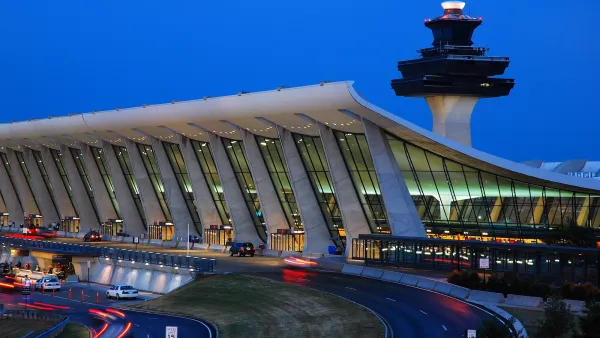
Trump wants to eliminate people movers, add 32,000-car garage to Dulles airport
The proposed renovations would cost roughly $22 billion.

Santa Monica residents argue historic airport is 'critical' for public safety
Some locals are asking the city to reconsider its planned closure of the airport in late 2028.

Planetizen Federal Action Tracker
A weekly monitor of how Trump’s orders and actions are impacting planners and planning in America.

California plans to bury El Niño’s downpour
If the state plays its cards right, it may be able to store a billion acre-feet of El Niño’s water in aquifers.

Desperate measures: Advocates weigh draining Lake Powell to fill Colorado River
Draining the reservoir could reduce evaporation losses by a couple hundred thousand acre-feet.

Mamdani’s pied-à-terre tax survives legal challenge
A panel of judges found that the plaintiffs failed to demonstrate injury as a result of New York City's implementation of the tax.

Eastern Nebraska is running out of electricity
Data centers and electrification are straining eastern Nebraska’s grid, throttling economic development.

Seattle passes record-breaking transit services expansion
Proposition 1 will double the city’s transit tax to add 95,000 more bus trips and preserve 180,000 bus trips annually.

FREE Course: Walkable City 1: Why Walkability?
After describing his path towards focusing on walkability as the essence of good planning, Jeff Speck marches through his five principal reasons for making more walkable places.
Reinventing Malls: Planning Alchemy—Turning Gray Fields Into Gold
The course focuses on the opportunities and imperatives that shape reinvention of mall sites.

City of Rosemead
Rutgers University, Edward J. Bloustein School of Planning and Public Policy
One Hundred Miles
Hunter College, City University of New York (CUNY)
The Architects Foundation
University of Cincinnati Online
City of Cambridge
Montrose County
The Pocatello Development Authority