High housing prices cannot be blamed on land conservation efforts, at least not in Silicon Valley, is the word from researchers at Stanford University.


Housing prices are known to be out-of-reach for many in the S.F. Bay Area, especially Silicon Valley, which also has a high amount of land spared from development through conservation efforts including urban growth boundaries.
"Developers have often blamed conservationists for the high costs by arguing that making land off-limits for new construction shrinks the area's housing supply and drives up prices.
But Stanford researchers say that argument holds little water. Only 51,000 more homes (a number equal to 6.5 percent of the 790,000 homes now in Silicon Valley) would have been built in the southern Bay Area's Silicon Valley if land had not been set aside by nonprofit groups and the government, they say.
Researchers for "the university's Bill Lane Center for the American West...analyzed whether land conservation efforts in Silicon Valley – which has about 116,000 acres of protected parks, forests, waterfronts and wildlife refuges have hurt housing development."
Thanks to Jeffrey Rensch
Read the full story: Stanford research shows Silicon Valley land conservation didn't hurt housing development

'Cap & Toll' Plan Proposed for Mountain View, California
To address the growth of commute traffic to the Google campus and neighboring tech companies in the north (of Hwy. 101) part of this city of 74,000 in Silicon Valley, the city council is proposing a toll on all three road entrances to the area.
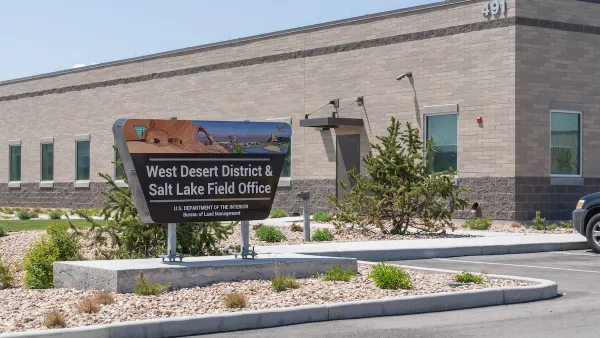
Public Lands Can Help Us Tackle the Housing Crisis in the West
The U.S. owns more than 650 million acres of public lands, and it has the power to sell or lease limited parcels for affordable housing. But mass disposal of public lands, as some legislators have proposed, is not the answer.

Community-Led Conservation: Protecting Elephant Hill’s Unique Biodiversity in Northeast LA
Community-led efforts are crucial in protecting the unique biodiversity of Elephant Hill in Northeast LA, with a focus on preserving the threatened Southern California black walnut tree and ensuring public access to this vital green space.

Planetizen Federal Action Tracker
A weekly monitor of how Trump’s orders and actions are impacting planners and planning in America.

Northwest rail fans eager for Sept. 30 debut of Amtrak’s Airo fleet
Get ready for that new train smell and more seats. But they won’t go faster or run more frequently on the Cascades route in Washington and Oregon.
Trump is considering data centers on 6 states' public land — some state officials say they had no idea
If the administration approves the proposed projects, data center and data center-related developments will cover 17,600 acres of public land.

California may destroy its beaches trying to save homes from El Niño
Boulders and seawalls can protect homes from waves, but ultimately destroy sandy beaches.

California high-speed rail accomplishes only one legislative goal in 2026
The majority of the agency's failed pitches were never developed into written proposals.

Sharp cuts to federal passenger rail, public transit funding arrive today
The American Public Transportation Associations estimates the stopgap bill will result in an over 80% cut to federal passenger rail investment and 20% cut to public transit investment.

FREE Course: Walkable City 1: Why Walkability?
After describing his path towards focusing on walkability as the essence of good planning, Jeff Speck marches through his five principal reasons for making more walkable places.
Reinventing Malls: Planning Alchemy—Turning Gray Fields Into Gold
The course focuses on the opportunities and imperatives that shape reinvention of mall sites.

City of Thousand Oaks
City of Wisconsin Rapids
Harvard University Graduate School of Design
The Architects Foundation
University of Cincinnati Online
Northern Illinois Transit Authority (NITA)
The Pocatello Development Authority
The Urban Renewal Agency of the City of Pocatello