In the next few months, the Dutch capital will make numerous changes to make its infrastructure greener. With the help of private companies like Cisco and IBM, Amsterdam is closer to becoming a "smart city" than any other in Europe.


"All told, the municipality, energy outfits, and private companies are expected to invest more than $1 billion over the next three years. That figure includes a $383 million investment by local electricity network operator Alliander in so-called 'smart grid' technology that uses network sensors and improved domestic energy monitoring to trim electricity use. Also part of the plan: up to $255 million to be spent by local housing cooperatives on boosting household energy efficiency, and $383 million from companies including Phillips (PHG) and Dutch utility Nuon to be invested in other energy-efficient technology.
'In the next year and a half, we expect to be the leading smart city in Europe,' says Ger Baron, senior project manager at the Amsterdam Innovation Motor, a public-private joint venture that is overseeing the project. 'We're in the right place at the right time.'
The focus on cutting cities' emissions could have a major impact on the battle against global warming. As of 2006, more people now live in urban areas than in the countryside, and the sprawl surrounding megacities such as Mumbai and Saõ Paolo is only likely to increase. Consultancy Accenture (ACN) reckons cities produce almost two-thirds of total global carbon dioxide emissions through a combination of car fumes, household energy use, and industrial manufacturing. In the coming years, policy shifts from the U.S. and elsewhere will put even more pressure on controlling carbon output."
Read the full story: Amsterdam as Smart City: Going Green, Fast

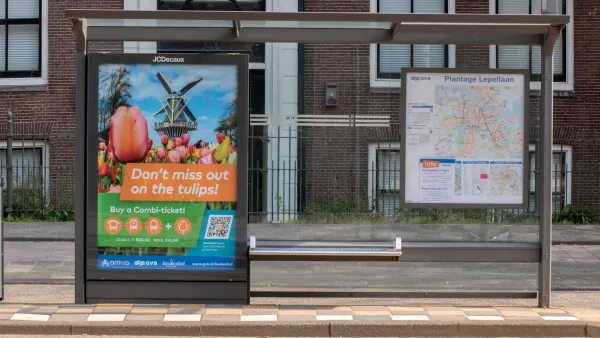
Amsterdam is First World Capital to Ban Ads for Fossil Fuels on Public Infrastructure
Several other Dutch cities have banned advertising for harmful or polluting industries on city-owned properties.
Amsterdam Public Transit's Big Move to All-Electric
Europe is well known for electric powered trams and trains, but cities still operate diesel buses, just like in the United States. That will change in Amsterdam—all diesel buses will be replaced by battery-electrics by 2025, reports Dutch News.
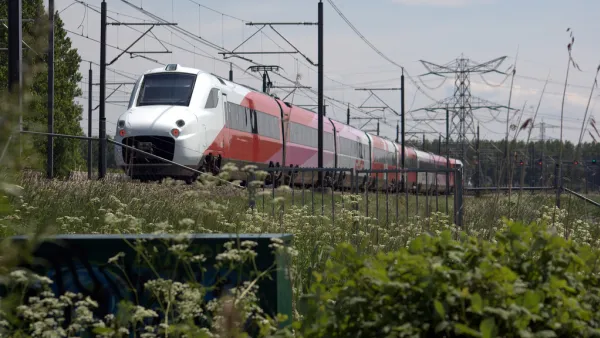
Dutch High-Speed Rail Dream Turns to Disaster
A multi-billion dollar project to expand high-speed rail service between Amsterdam and Brussels has been derailed by malfunctioning trains, costing the head of the Dutch national rail company his job and threatening an international imbroglio.

Planetizen Federal Action Tracker
A weekly monitor of how Trump’s orders and actions are impacting planners and planning in America.

‘Going backwards:’ Baltimore mayor, students rally against state's transit funding plan
Maryland's proposed six-year plan provides no funding for Baltimore’s BMORE bus program and reduces its road maintenance funding.

Mamdani sent nearly 6,000 pied-à-terre tax warnings to homes that didn’t qualify
A judge has ordered the administration to cancel thousands of pied-à-terre tax notices after it sent 35% of them erroneously.

Mamdani sent nearly 6,000 pied-à-terre tax warnings to homes that didn’t qualify
A judge has ordered the administration to cancel thousands of pied-à-terre tax notices after it sent 35% of them erroneously.

Detroit to transform waterfront with $2.2 billion investment
Developers will convert about 18 acres of unused parking lot space into civic spaces.

‘Going backwards:’ Baltimore mayor, students rally against state's transit funding plan
Maryland's proposed six-year plan provides no funding for Baltimore’s BMORE bus program and reduces its road maintenance funding.

FREE Course: Walkable City 1: Why Walkability?
After describing his path towards focusing on walkability as the essence of good planning, Jeff Speck marches through his five principal reasons for making more walkable places.
Reinventing Malls: Planning Alchemy—Turning Gray Fields Into Gold
The course focuses on the opportunities and imperatives that shape reinvention of mall sites.

City of Thousand Oaks
City of Wisconsin Rapids
Harvard University Graduate School of Design
The Architects Foundation
University of Cincinnati Online
Northern Illinois Transit Authority (NITA)
The Pocatello Development Authority
The Urban Renewal Agency of the City of Pocatello