Fifty years ago, Kenneth E. Norwood placed a time capsule and his predictions for Burbank, CA in a newly constructed bridge. According to the planner, monorails and "multi-unit garden apartments" were the waves of the future.


"Spend a moment on the predictions of Kenneth E. Norwood of Burbank's Planning Department. He envisioned a city where only 12% of the people lived in single-family homes, with 88% in multi-unit garden apartments made of plastic that were incorporated in commercial complexes. 'These complexes are supposed to be the ultimate in urban living, combining offices, hotels, apartments, shops, restaurants, etc., in one continuous complex of buildings, malls and arcades,' he wrote.
There would be no overhead wires or antennas, he said. Instead, Burbank would use underground atomic power with electricity distributed by waves.
'Rapid monorail routes connect metro centers, with pickup stations at the Lockheed Air Control Center, and at each of the main malls in Burbank,' Norwood wrote. 'Unlike auto parking in 1959, there is no parking on streets or open lots but in fully automatic parking units located at each main destination point.'
Read the full story: Burbank Time Capsule Revisited


California TOD Law Gives NIMBYs a new Weapon Against Bus Lanes
A new law that allows rezoning for higher density near transit lines is fueling opposition to a Burbank bus rapid transit line.
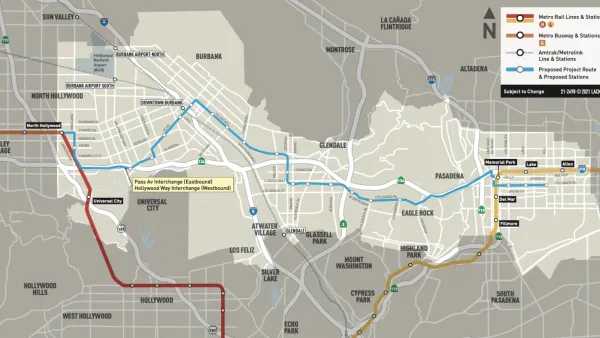
Controversial North Hollywood-Pasadena Bus Rapid Transit Line Approved
A controversial project to connect the San Fernando and San Gabriel valleys by bus rapid transit has final approval. Los Angeles, Glendale, Burbank, and Pasadena will have a new connecting transit line as soon as 2024.
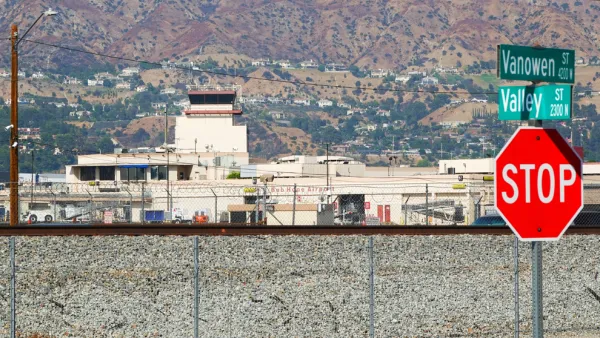
Hollywood-Burbank Airport’s Replacement Terminal Project Moves Forward
Bud Ovrom, one of Burbank’s Commissioners on the Burbank-Glendale-Pasadena Airport Authority, gives an update on the Airport’s capital improvement plans. Ovrom also opines on the challenges of federal preemption over air transport in Los Angeles.

Planetizen Federal Action Tracker
A weekly monitor of how Trump’s orders and actions are impacting planners and planning in America.

‘Going backwards:’ Baltimore mayor, students rally against state's transit funding plan
Maryland's proposed six-year plan provides no funding for Baltimore’s BMORE bus program and reduces its road maintenance funding.
Mamdani sent nearly 6,000 pied-à-terre tax warnings to homes that didn’t qualify
A judge has ordered the administration to cancel thousands of pied-à-terre tax notices after it sent 35% of them erroneously.

Mamdani sent nearly 6,000 pied-à-terre tax warnings to homes that didn’t qualify
A judge has ordered the administration to cancel thousands of pied-à-terre tax notices after it sent 35% of them erroneously.

Detroit to transform waterfront with $2.2 billion investment
Developers will convert about 18 acres of unused parking lot space into civic spaces.

‘Going backwards:’ Baltimore mayor, students rally against state's transit funding plan
Maryland's proposed six-year plan provides no funding for Baltimore’s BMORE bus program and reduces its road maintenance funding.

FREE Course: Walkable City 1: Why Walkability?
After describing his path towards focusing on walkability as the essence of good planning, Jeff Speck marches through his five principal reasons for making more walkable places.
Reinventing Malls: Planning Alchemy—Turning Gray Fields Into Gold
The course focuses on the opportunities and imperatives that shape reinvention of mall sites.

City of Thousand Oaks
City of Wisconsin Rapids
Harvard University Graduate School of Design
The Architects Foundation
University of Cincinnati Online
Northern Illinois Transit Authority (NITA)
The Pocatello Development Authority
The Urban Renewal Agency of the City of Pocatello