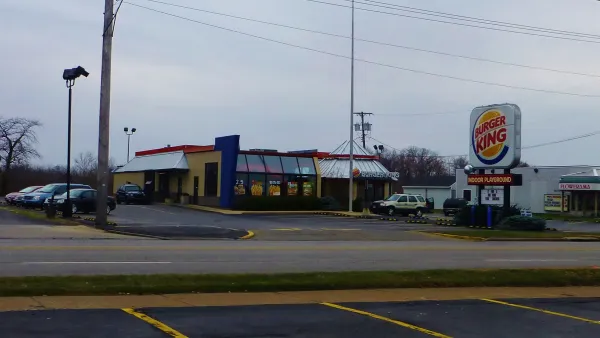
A moratorium on new fast food restaurants in Los Angeles is seen as a way to encourage better public health, but also a way to encourage healthier businesses.


"Even in a country where a third of the schoolchildren are overweight or obese, the yearlong moratorium raises questions about when eating one style of food stops being a personal choice and becomes a public health concern."
"The Sisyphean struggle against poor diets has included booting soda from schools, banning trans fat and, more recently, sending New Yorkers into dietary sticker shock with a law that requires calorie counts be posted on menus, right next to the prices."
"But this appears to be the first time a government has prohibited a specific style of restaurant for health, rather than aesthetic, reasons."
"Jonathan Gold, the LA Weekly food critic who won a Pulitzer Prize last year, said he understands the spirit of the freeze, which is an urban planning measure meant to keep the neighborhood, South Los Angeles, from being swallowed up by drive-though fast food restaurants. (A separate measure by the city provides economic incentives for new grocery stores and restaurants with table service.)"
Read the full story: Los Angeles Stages a Fast Food Intervention
Fighting Food Deserts in Los Angeles
Public health analysts and justice activists are tackling food deserts in a state known for its agricultural output. Low-income neighborhoods of color are the hardest hit by a lack of grocery options.
First Fast Food, Now South L.A. Looks to Ban Convenience Stores
Community activists are calling for a ban on new convenience stores in South Los Angeles, a lower income part of town that saw a ban on new fast food restaurants last year.
Fast Food Ban Doesn't Trim the Fat
A ban on new fast food restaurants in South Los Angeles which was put in place last year has been found to play little role in reducing obesity in the area, according to a new report from the Rand Corporation.

Planetizen Federal Action Tracker
A weekly monitor of how Trump’s orders and actions are impacting planners and planning in America.

California plans to bury El Niño’s downpour
If the state plays its cards right, it may be able to store a billion acre-feet of El Niño’s water in aquifers.

Desperate measures: Advocates weigh draining Lake Powell to fill Colorado River
Draining the reservoir could reduce evaporation losses by a couple hundred thousand acre-feet.

Seattle passes record-breaking transit services expansion
Proposition 1 will double the city’s transit tax to add 95,000 more bus trips and preserve 180,000 bus trips annually.

Post election, Texas is no longer Musk’s 'AI oasis'
Elon Musk dolled out $446 million on the 2026 midterms, the most ever spent by a non-canidate.

Chicago voters approve permanent festival grounds, penalty for vacant property owners
Currently, major summer and fall festivals take over public parks for weeks at a time, drawing criticism from nearby residents

FREE Course: Walkable City 1: Why Walkability?
After describing his path towards focusing on walkability as the essence of good planning, Jeff Speck marches through his five principal reasons for making more walkable places.
Reinventing Malls: Planning Alchemy—Turning Gray Fields Into Gold
The course focuses on the opportunities and imperatives that shape reinvention of mall sites.

City of Rosemead
Rutgers University, Edward J. Bloustein School of Planning and Public Policy
One Hundred Miles
Hunter College, City University of New York (CUNY)
The Architects Foundation
University of Cincinnati Online
City of Cambridge
Montrose County
The Pocatello Development Authority