The UCLA Luskin Center for Innovation offers expert guidance on LA wildfire response and recovery, addressing critical issues like water safety, air quality, equitable rebuilding, and climate adaptation to promote resilience and sustainability.


The UCLA Luskin Center for Innovation is offering expert guidance to support Los Angeles in addressing the immediate and long-term challenges posed by recent wildfires. The center’s experts are available to provide insights into key areas, including water supply and quality, air quality impacts, equitable land use and recovery planning, and the governance and politics of disaster response. Their goal is to help policymakers and communities navigate this crisis with evidence-based strategies that prioritize resilience, equity, and sustainability.
Gregory Pierce, co-executive director of the Luskin Center, emphasizes the need for improved coordination in water testing, treatment, and public communication to ensure safety and trust in drinking water systems impacted by wildfires. Rachel Connolly, an air quality and environmental equity researcher, highlights the dangers of wildfire smoke, recommending N95 masks, air purifiers, and updated school HVAC systems while advocating for better air quality monitoring tools to address toxic pollutants released during urban fires.
Land use and recovery planning are also priorities, with Megan Mullin urging a community-driven approach to rebuilding that prioritizes equitable investment and resilience rather than exacerbating existing inequalities. Edith de Guzman, a specialist in water equity and climate adaptation, brings critical expertise on the effects of extreme weather, such as the erratic Santa Ana winds that fueled the fires, underscoring the need for adaptive infrastructure and policies to mitigate future risks.
By addressing these interconnected challenges, the UCLA Luskin Center provides a comprehensive resource for leaders and residents. Their insights on disaster governance, the politics of response, and the broader impacts of climate whiplash aim to equip Los Angeles with the tools needed to recover from the immediate crisis while building long-term resilience against climate-driven disasters.
FULL STORY: UCLA Luskin Center for Innovation Research and Commentary on the LA Fire Response and Recovery

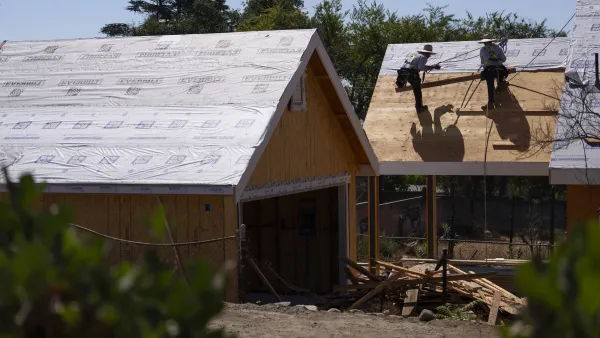
One Year After the LA Fires, Just 13% of Damaged Homes Have a Rebuilding Permit
After a slow start, permitting is starting to pick up.
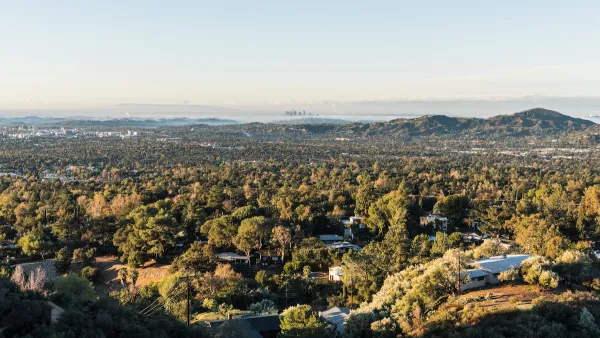
Half of Altadena’s Black Homes Lost or Damaged in Eaton Fire
The community has higher Black homeownership rates than most of Los Angeles, but now faces an uncertain future as residents struggle to rebuild.
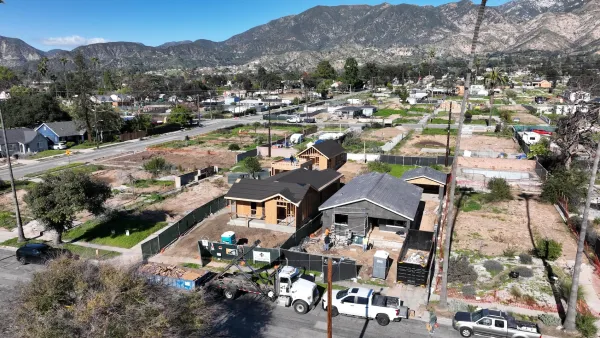
Almost 40% of LA fire survivors face a housing crisis
Many Angelenos who lost their homes in the Altadena and Pacific Palisades fires have already run out of temporary housing funds.

Planetizen Federal Action Tracker
A weekly monitor of how Trump’s orders and actions are impacting planners and planning in America.

The state-sanctioned urbicide of Austin
People don’t kill cities. Freeways do.

US to reduce Colorado River water deliveries to Mexico
A new Colorado Treaty amendment reduces Mexico’s Colorado River water allocation by 250,000 acre feet.

5 New England states march closer to 800 megawatt wind energy project
Securing federal approval for the project may be complicated under the Trump administration, which has historically been hostile towards domestic wind power.

Baltimore to break ground on $50 million Transit Priority Project
The project will bring faster bus trips, safer streets and better bike connections to Baltimore.

Airbnb launches $250 million 'last-dollar financing' housing accelerator, makes first investment in Austin
The company will put $6.4 million towards affordable housing development in Texas’ capital.

FREE Course: Walkable City 1: Why Walkability?
After describing his path towards focusing on walkability as the essence of good planning, Jeff Speck marches through his five principal reasons for making more walkable places.
Reinventing Malls: Planning Alchemy—Turning Gray Fields Into Gold
The course focuses on the opportunities and imperatives that shape reinvention of mall sites.


Eagle County Government
Harvard University Graduate School of Design
Nashville Planning Department
The Architects Foundation
University of Cincinnati Online
The Pocatello Development Authority
The Urban Renewal Agency of the City of Pocatello
Journal of the American Planning Association